
Why Conventional vs. Organic Cotton Bags Impact Water Footprint Calculations in Corporate ESG Reports

Two cotton totes, same size. One is organic cotton from rainfed farms in India. The other is conventional cotton irrigated in Turkey. Use published farm-stage numbers and the organic bag ends up with the bigger total water footprint, while the conventional one drinks about seven times more irrigation water. So which is the lower-water bag? Honestly, it depends on which number you print, and your auditor will ask why you chose that one. This article is about that gap. If your water disclosure covers organic cotton bags bought from a supplier, you’ll see where the usual figures come from, which ones survive assurance and which claims are better dropped. We also get into BRSR Core and Scope 3 style reporting, because that’s where most Indian teams will run into this question. Quick background on us. Anges Bags makes more than 48 million eco-friendly bags a year for customers in over 64 countries, so we see the manufacturing side of this data: fabric weight, panel size, cutting waste. We don’t farm. Where our numbers end and the farm’s begin is covered further down. Cotton water comes in three colours Green, blue and grey. Squashing them into one number is where most of the trouble starts. Green is rain that the soil holds and the plant uses. Blue is water pumped from rivers or underground for irrigation. Grey isn’t water used at all. It’s the clean water you’d need to dilute fertiliser and pesticide runoff down to a safe level. For crops overall, Mekonnen and Hoekstra put the global split at roughly 78 percent green, 12 percent blue and 10 percent grey in their study in Hydrology and Earth System Sciences. Cotton’s behaviour is not like any normal crop. A US industry figure, “Cotton Incorporated”, mentioned a Water Footprint Network range of When the spread is that wide, a single global figure deserves some suspicion.1,500 to 65,000 cubic metres per tonne of cotton In Kuyichi’s water footprint report the field dominates. Ginning is assumed at 40 litres per kilogram of fibre, while the farm stage runs into the thousands. Spinning, weaving and dyeing use water as well, and we’ve left them out of the example below, but for the raw fibre the field is where the volume sits. The study everyone quotes, and who paid for it The comparison you’ll see in most sustainability decks comes from a 2014 Textile Exchange life cycle assessment. Its headline: 91 percent lower blue water consumption for organic cotton, and 46 percent lower global warming potential. The data came from producer groups in India, China, Turkey, Tanzania and the United States. According to the Global Organic Textile Standard summary, GOTS and 13 other Textile Exchange members funded it. That doesn’t make it wrong. It’s just something you should know before leaning on it, and the trade magazine Ecotextile wondered at the time whether the comparisons were really valid. The headline doesn’t matter against two details. The 91 percent is blue water only, not total water. And the same study found that about 95 percent of the water in organic cotton is green, meaning rain. Put simply, the organic advantage in that data is mostly that those farms depend on rainfall instead of pumps. Textile Exchange replaced the old numbers in March 2026 with a new cotton assessment covering nine countries. It points to field emissions from synthetic nitrogen fertiliser as the biggest source of impact in most systems, and says outcomes depend on where the cotton grows and how it’s managed (Textile Exchange announcement). Carbonfact has built the new data into its tools. Its review states that organic cotton doesn’t necessarily use less water than conventional, since geography drives the result, and it admits real uncertainty around organic yields and irrigation. Run the numbers on a real tote Kuyichi’s 2021 water footprint report gives two farm-stage figures we can borrow. Indian organic cotton: the figures are 5,236 litres per kilogram, it is made up of 4,646 green, 320 blue and 270 grey. Conventional cotton from Turkey: 3,020 litres per kilogram, with 470 green, and 2,330 blue and about 220 grey. These came from different studies and research and from different years, so it is not advisable to make it as a ranking of countries. It only shows how differently the mix can fall. Let’s take a plain tote, which needs 100 grams of cotton that includes cutting waste, and you have an order of 100,000 pieces. The weight of the fibre is 10,000 kilograms. Farm stage only: Fibre source Total water Green water Blue water Grey water Organic, India 52.4 million litres 46.5 million litres 3.2 million litres 2.7 million litres Conventional, Turkey 30.2 million litres 4.7 million litres 23.3 million litres 2.2 million litres The organic fibre carries about 1.7 times the total volume but only a seventh of the blue water. Print just the total and you’ll tell procurement the opposite of what a water stress review would. Two other things shift the number, and they rarely get a mention. One is weight.. The amount of cotton is the factor to know the footprint,so a 280 gsm bag holds double the water of an same bag with 148 gsm, whatever fibre it is using. The other is reuse. At 100 grams, the Indian organic figure comes to about 524 litres a bag and the Turkish conventional one to about 302. Over 10 uses that’s roughly 52 or 30 litres each time. Over 100 uses it’s a tenth of that. The number of times someone carries the bag moves the per-use figure tenfold, which dwarfs the 1.7 times gap between these two fibres. Hardly any ESG report records how often a promotional tote gets used. Grey water is where farming methods really split One number which separates organic with conventional farming is the grey water. 700 farms from Gujarat, Maharashtra and Madhya pradesh are compared with three sets of practices as studied by Water Footprint Network. Its conference abstract says that if every farm
Why HR Teams Are Adding Personalised Jute Bags to Remote Onboarding Welcome Kits

Here’s our position, and you’re free to disagree with it: a welcome kit should be designed for month six, not for the unboxing photo. Pick the one thing you’d like the employee to still be using half a year in, then build everything else around it. For a growing number of HR teams that one thing is a bag, and more specifically personalised jute bags that go to the market, the gym and the metro with your company’s name on the side. We make jute bags, so we’re not neutral. Read the rest with that in mind. We cover what onboarding research does and doesn’t show, how jute compares with cotton and non-woven bags on points your procurement team can check, and the planning slips that make a kit arrive late. When a figure comes from a vendor survey, or when something is just our opinion, we say so. Where Remote Onboarding Falls Short Most onboarding conversations start with Gallup, and for good reason. Only 12% of employees strongly agree their organisation does a great job of onboarding, and new hires usually need about 12 months to reach full performance. Gallup also found that when a manager takes an active part, employees are 3.4 times as likely to call their onboarding exceptional ([Gallup](https://www.gallup.com/workplace/247172/problems-onboarding-program.aspx ). None of that is specific to remote hires. Still, it tells you something useful: the first week is a tiny slice of a year-long ramp, so the real question is whether anything from that week stays around afterwards. Remote seems to make things harder. AIHR’s roundup of recent surveys has remote onboarding scoring below in-person and hybrid on satisfaction ([AIHR](https://aihr.com/blog/employee-onboarding-statistics ). The staffing firm Insight Global asked more than 900 full-time employees and contractors, and 80% said a better onboarding experience would keep them in a job longer ([Insight Global](https://insightglobal.com/blog/employee-onboarding-statistics ). That’s one firm’s sample, so don’t plug it into your attrition forecast. Why a Physical Kit Still Matters When Work Is Digital Here’s the odd thing about a fully remote first week: nothing in it can be held. A kit changes that, but only if it arrives on time. Custom Ink, which sells merchandise, ran its own 2026 onboarding audit. Its numbers: 34% of people who got a kit on day one felt they belonged from the start, against 18% with no kit. A kit that turned up late did about as little as none ([Custom Ink](https://www.customink.com/blog/sustainable-corporate-gifts-guide/ ). It’s a vendor’s survey, so take it as a hint. The dispatch rule it suggests is still sensible, and the sum is simple. Say your courier quotes three working days to the employee’s city, and you want the box there two working days before the start. Dispatch five working days before joining. Do that sum for each city, not once for the whole batch. Our own test for what goes in the box is an opinion, not research. Will the person use it outside working hours in the first month? Notebooks mostly fail. A bag big enough for groceries or gym clothes mostly passes. Packwire sees a similar move away from bulk swag towards fewer things people keep ([Packwire](https://packwire.com/blog/corporate-swag-evolution-welcome-kits ). How Jute Compares, Including Where It Loses Start with the rule change, because it set the direction. India’s ban on identified single-use plastic items took effect on 1 July 2022, with thinner plastic carry bags to be swapped for thicker ones, and coverage at the time listed paper, jute, glass and wood among the alternatives ([AP via Gulf News](https://gulfnews.com/amp/world/asia/india/india-bans-some-single-use-plastic-as-part-of-broader-plan-1.88973371 ). Some employers went beyond the minimum. NTPC, a Maharatna public sector company, banned single-use plastic at its premises and gave employees jute bags for everyday use ([PSU Watch](https://psuwatch.com/national-news/ntpc-bans-single-use-plastic-in-all-its-premises ). A welcome kit in a polybag, or a printed polypropylene tote, sits oddly next to that. Then there’s the fibre. Outlook Business, in a feature quoting the National Jute Board, says jute grows on rainfall without heavy irrigation or synthetic fertiliser, and that the fibre is biodegradable and compostable ([Outlook Business](https://www.outlookbusiness.com/planet/initiatives/jute-indias-golden-fibre-in-the-battle-against-plastic-pollution ). India is the largest producer, so a local-sourcing claim is checkable. Ask where the fibre was spun and woven. None of this makes jute the right pick every time. Here’s what it costs you. Material Breaks down naturally Weight and shipping Printing Main drawback Jute Yes for the fibre; a lamination layer changes how the bag is disposed of Heavier than non-woven, which adds to courier cost on overseas parcels Bold logos in flat colours; the weave limits fine detail Textured surface, weight Cotton canvas Yes Lighter than jute Holds finer and more detailed artwork Conventional cotton needs more water to grow Non-woven polypropylene No, it is plastic-based Light and cheap to ship Prints cleanly Works against plastic-reduction goals Thin polybag No Lightest Limited Usually single use What HR Gets Out of It, and What It Doesn’t Fix A bag won’t repair a poor manager relationship or a muddled first week. What it can do is smaller, and easier to defend. Feeling noticed A generic box tells the employee the company ships boxes. A first name or team name on the bag tells them someone read the joining list. Still, if we had to pick the best-value item in the whole kit, it wouldn’t be the bag. It would be a handwritten note from the new hire’s own manager. Gallup’s finding on manager involvement points that way, and the note costs a pen and five minutes. Employer brand, at street level A mug gets seen on camera. A bag gets seen on the metro by strangers. Whether that turns into referrals, we don’t know, and we haven’t found a study that measures it. Sustainability numbers you can defend The welcome kit is one of the few items HR controls from order to doorstep, so it’s easy to document. Keep the number of bags, the fibre, the supplier and any certificates on file. Then the sustainability report can carry a figure instead of a vague line like “eco-friendly welcome kit”. Custom Ink’s survey found that 69%
How to Spot Genuine Organic Jute Bags: A Material Auditor’s Guide to Weave Density, Dye Testing, and Certifications
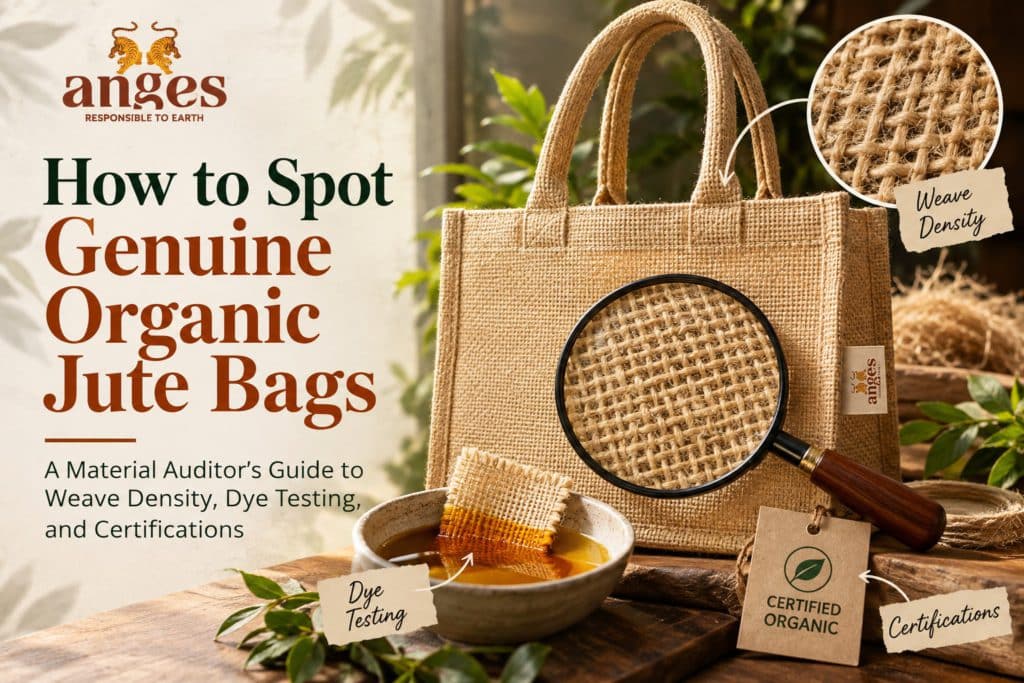
Flip through a few supplier catalogues and you’ll notice that jute bags all get the same four adjectives: natural, eco, green, organic. The copywriter shuffles the order and moves on. With only one of those four words will place an inspector behind it and it is most possible to be printed without any inspections from the Inspector. Therefore whenever you are sourcing any Organic Jute Bags for your brand launch, corporate bulk gifting or your store, the green tag on the sample will not prove anything. You need to know what went through before the jut becomes the bag. At Anges Bags we make over 48 million eco-friendly bags a year and ship to more than 64 countries, which means we spend a lot of time around jute cloth, and around the paperwork that is supposed to describe it. This article is the checking routine we’d follow if someone handed us an unfamiliar sample. Physical tests come first. Documents come second, and they matter more. Near the end there’s a short calculation that takes five minutes and catches a mistake you won’t find by looking at a logo. First, an Honest Limit Nothing on your desk can show whether jute was grown organically. A ruler, a lighter, a kitchen scale and a damp rag can’t see the field, and they can’t see who handled the fibre afterwards. I’m saying this up front because a lot of “how to spot organic” advice online quietly implies that a burn test or a sniff test proves the claim. It doesn’t. What the physical checks do well is eliminate bad samples cheaply. If a cloth fails them, you’ve saved yourself a round of document chasing. If it passes, all you’ve earned is the right to start asking for certificates. Weave and Weight Hold a piece of the cloth up to a window and look at how the light comes through. Jute is never perfectly even, so don’t expect it to be. Small thick bumps in the yarn, called slubs, are everywhere in the stuff and don’t mean anything. Gaps you can read a newspaper through are a different story, since they usually point to thinner yarn. To get a number, lay a ruler on the cloth and mark one inch. Count the threads running lengthways, then the ones running across, with a magnifier if needed. There’s no universal right answer here because the count changes with cloth grade and with what the bag is expected to carry. The useful move is to compare your count with the supplier’s specification sheet. If they haven’t got a spec sheet, you’ve already learned something. Weight is harder for a supplier to get away with. Cut a square exactly 10 cm by 10 cm, weigh it to the nearest tenth of a gram, and multiply by 100. That’s your GSM, grams per square metre. Hessian cloth has traditionally been sold by the ounce, measured per yard at 40-inch width, so a 10 oz cloth lands near 305 GSM and a 7.5 oz cloth near 230. Say you were quoted 10 oz and your square weighs 2.1 g. That works out to 210 GSM, a long way short, and I’d email the supplier that figure and wait to see how they respond. Is It Jute at All? Take the cloth and rub it between your finger and thumb. The characteristic of jute is dry, it is stiff and a little scratchy, the finish is dull, with gold to tan in colour, it will also leave tiny bits on your skin. Some makers use polypropylene yarn with it , to make it water resistant and to make them a slicker and a bit shiny texture when put under a light. If the above guide didn’t help someone, we can try to burn one of its thread. Hold it with something like a tweezer and keep a glass of water close. The burning of jute is slow, with a smell of dry grass and paper. Its ash is soft and grey. If polypropylene is used it will curl away and melts leaving behind a hard little bead. Half a minute settles it. Laminated bags are their own question. We make a lot of them, because lamination keeps a retail bag stiff and keeps rain out. But the coating is usually a plastic film on top of the jute, and a plastic film isn’t organic fibre. A laminated bag can sit under a certificate, but only if the paperwork shows how the coating is treated. When a seller calls one “fully organic” without saying anything about the lamination, ask. Dye Is Where Things Usually Slip Raw jute is tan, gold or brown. Anything brighter, such as teal, maroon or a clean black, means a dye house got hold of it, and under GOTS the dyes and other chemicals used in that step have to meet set criteria. Plenty of people assume that certified fibre gives you a certified bag. It doesn’t, quite. A bag can begin with certified fibre and fall outside the standard because of what happened at the dye stage. Three cheap tests will give you a first read. Take a piece of cotton and wet it and then rub it firmly on the coloured area for about thirty seconds. Dark shades can leave very little to know what is the quality, but a stained cloth is a sign of a weak fixation. After this, drop a small amount of swatch in warm water for 30 minutes, and then press it in between paper towels. If the paper towel is stained or the water becomes colour , then it means it is bleeding. Take notice how the swatch is smelling while it is still in wet condition. Jute smells like earth and a bit of hay, mixed. A sharp chemical essence confirms leftover dye or finishing agent. One jute quirk to know about: the fibre is normally softened with a batching oil before spinning, so a mild oily note
How to Care for and Repair a Heavy-Duty Cotton Backpack to Extend Its Lifespan for Decades
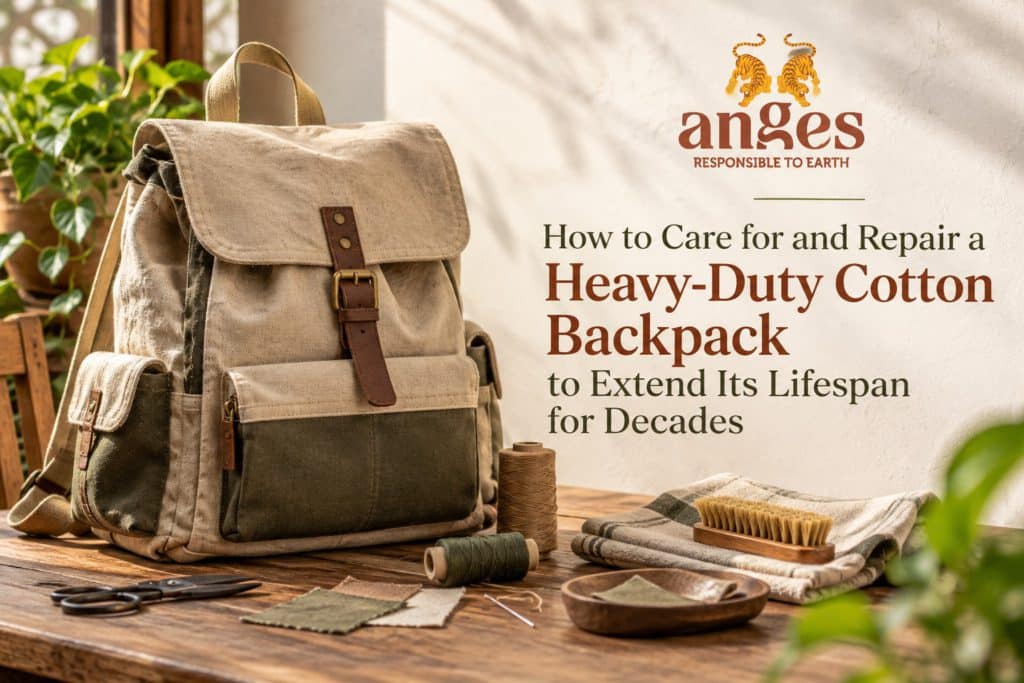
Pick up a backpack that someone has thrown away and look at it closely. Most of the time the canvas is fine. One strap anchor has pulled through half its stitches, one zipper has opened up behind the slider, one bottom corner has worn to the weave. Those three spots, and not the fabric, decided that the bag was finished. That is the real case for a heavy-duty Cotton Backpack. Thick woven cotton lets you get at the damage. You can unpick a seam, lay a patch, swap a slider and re-stitch a strap with a needle, some thread and an evening. Bags with bonded seams and laminated panels rarely allow that, so the same small failure sends them to landfill. Anges makes more than 48 million bags a year for buyers in over 64 countries, and the weak points repeat with a dull regularity from one order to the next. This guide is organised around those weak points, in roughly the order they fail, and around the repairs that hold up under daily use. Where the Load Goes, and Where the Bag Gives Way A loaded backpack pulls down on two strap anchors and the top handle. Everything in the bag hangs from a few centimetres of stitching in each place. The canvas beside that stitching is carrying almost nothing, because the thread takes the strain first. Stress also piles up where a line of stitching ends. The last few needle holes carry a disproportionate share, and that is where a seam usually starts to unzip. This explains why a strap can hold for two years and then go in an afternoon. The first stitches gave up quietly, and each failure handed more load to the next. Bottom corners fail for a different reason. Nothing is being pulled. The bag is simply set down on floors several times a day, and the yarns at the corner lose a fraction of their thickness each time. Zippers wear from the inside out, since grit sits in the slider and polishes it smooth. The fabric itself comes last, usually after years of sun or repeated damp. If you only have time for one habit, make it a monthly tug on each strap near its anchor, then a look along the base seam. Ten minutes of re-stitching at that point saves the afternoon it takes once a strap has torn out with a piece of canvas attached. Let the Thread Be the Weak Link Many people assume the strongest possible thread is best. On a bag you plan to keep for years, the opposite logic is sounder. If the thread is stronger than the canvas, an overloaded seam won’t open. The canvas will rip beside it, and a rip in cloth is far harder to fix than a run of loosened stitches. If the thread is well matched to the fabric, or a little weaker, an accident costs you a seam you can re-sew in fifteen minutes. In effect the stitching acts as a fuse. For most bag canvas that means bonded polyester or nylon in the Tex 70 to Tex 90 range (often sold as size 69 or 92). Polyester holds up better in sunlight, so it suits a bag that lives outdoors. Nylon is slightly stronger but degrades faster under ultraviolet light. Avoid cotton thread on a bag that might get damp, because the same mildew that attacks canvas eats cotton thread first. Read the Canvas Before You Repair It Canvas is usually sold by weight in ounces per square yard, and one ounce works out to about 34 GSM. Canvas weight Approximate GSM Typical use 10 oz 340 Tote bodies, light daily bags 12 oz 407 General-purpose backpacks 15 oz 509 Work bags, heavy-duty packs 18 oz 610 Tool bags, field carry The number matters for repairs because a patch should be close to the weight of the bag. A thin patch on a heavy bag stretches at a different rate from the cloth around it, so it puckers and works loose at the edges. Canvas is a plain-weave fabric traditionally made from cotton or linen, and its long use in tents, sails and workwear tells you it tolerates punishment. Find out whether the bag is waxed. Waxed canvas repels water, can’t be machine washed, and resists most adhesives. Unwaxed canvas is more forgiving to clean and easier to patch. The advice below flags where they differ. Water, Sun and the Mildew Problem A common belief holds that getting cotton wet weakens it. It doesn’t. Cotton fibre is a little stronger wet than dry, which is why sailcloth was made from it. What harms a Cotton Backpack is staying damp. After rain, empty the bag, open every pocket and let it dry at room temperature. Keep it away from radiators, which can stiffen and shrink the cloth, and out of hard direct sun. A bag stored damp will grow mildew. You will smell it first, then see grey or black speckling, and the fibres slowly lose strength. Owners often put this down to age, which is why so many bags seem to fade suddenly after one wet season in a cupboard. Ultraviolet light is the other slow enemy. Dyed canvas fades, and cotton fibre degrades over years of exposure. A bag hung on a balcony hook every summer, or left on a car parcel shelf, ages faster than one kept indoors. Washing: Less Than You Think Every full wash removes some of the sizing that gives new canvas its body, and every machine cycle puts a strain on stitching and hardware. For a bag in daily use, one or two full washes a year is plenty. Spot cleaning and brushing can cover the rest. Start with the dry methods. Turn the pockets out and shake them. Run a brush or a vacuum attachment along the inside seams, where crumbs collect. Let mud dry completely before brushing it away, since rubbing wet mud into canvas sets it. For marks, use
Comparing Muslin, Calico, and Twill Weaves in Cotton Bags: Which Material Fits Your Packaging Needs?
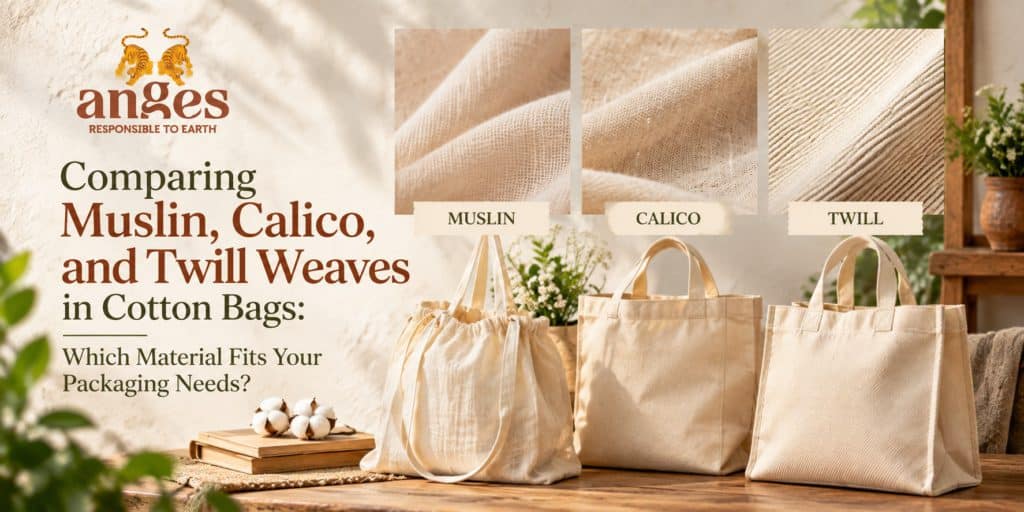
Two enquiries can reach us on the same morning and look almost identical. A jeweller wants pouches for earrings. A grocery chain wants carry bags for its stores. Both write “cotton,” and both are asking for cotton bags. If we quoted the same fabric for both, one of them would be back within a month. Either the pouch fabric would split at the seams under a few kilos of tins, or the gift pouch would feel like a feed sack. The difference is the weave. Cotton is only the fibre. How the yarns cross each other decides how the cloth carries weight, takes ink, drapes on a shop counter and what it costs per piece. At Anges we produce over 48 million bags a year for buyers in more than 64 countries, and the correction we make most often at the start of an order is a weave that doesn’t suit the product. This guide compares muslin, calico and twill on the points that actually decide that match, and it includes the checks we’d run before approving any fabric. GSM Is Useful, but It Doesn’t Tell You Everything GSM stands for grams per square metre, and most quotations lead with it. More grams generally means more cotton in the cloth, which brings more strength, more stiffness and a higher price. But GSM measures mass, not construction. Picture two fabrics that both weigh 150 GSM. One is woven tightly from fine yarn. The other is woven loosely from thick yarn. The tight one usually resists seam slippage better, while the loose one feels fuller in the hand. Same number, two different bags. Two other things are worth knowing before you compare quotes. First, GSM has a tolerance. Suppliers commonly work to around plus or minus 5 percent, so a “160 GSM” cloth could legitimately measure anywhere from about 152 to 168. Now if you have any custom specifications, specify the tolerance with the order, next, the weighing is normally done after the finished product after sizing, means after bleaching or dyeing, and this affects the number. Ask which stage the figure refers to. Names add another layer of confusion. In India, the UK and Australia, calico means plain, usually unbleached cotton. In the United States it often means a printed cotton with a small floral pattern. Muslin is called mulmul in much of India, and heavier twill is often sold as drill. So when you send a specification, give the weave, the GSM with tolerance and the finish (bleached, unbleached, dyed, pre-washed). A name alone invites a different fabric from the one you had in mind. Muslin: Light, Soft and Slightly See-Through Muslin is a plain weave. Each weft yarn goes over one warp yarn, under the next, and repeats. What makes muslin what it is comes down to two things: fine yarn and an open structure. Dhaka muslin from Bengal was prized for centuries because the yarn was spun so thin, and Wikipedia’s muslin entry covers that history well. For bags, muslin usually stays under 140 GSM and is often far lighter. It drapes rather than standing up, which is why drawstring pouches are its natural home. Buyers tend to overlook three things with muslin. The first is that it’s translucent. A dark tea tin or a red spice sachet will show through the cloth, so check the fabric against your real product before you sign off. The second is that the open weave lets yarns shift. Pinch two neighbouring threads near the cut edge of a swatch and slide them apart. If they move easily, that cloth will slip at the seam under load, and you’ll see puckering or tiny gaps along the stitch line. The third is that fine print struggles on it. Small text and hairline strokes lose definition on a soft, uneven surface, so a single-colour logo with bold strokes works far better than a detailed crest. Muslin suits jewellery, loose tea, dried flowers, candles, wedding favours and sample sachets. It’s a poor choice for anything with hard corners, real weight or a long working life. And a drawstring closure puts all the strain on one small channel of fabric, so if the pouch will hold anything heavier than a few hundred grams, ask for a double-folded casing. Calico: Where Most Retail Orders Should Start Calico is also a plain weave, but the yarn is thicker and the cloth is packed more closely. It’s usually sold unbleached, which explains the cream colour and the occasional dark speck of cotton husk. The name is commonly traced to Calicut, now Kozhikode, on the Kerala coast, from where the cloth was exported. There’s a longer account of calico’s history if you want it. Calico for bags typically sits between 120 and 200 GSM. Some points that rarely make it into supplier brochures: New calico often carries starch sizing left over from weaving, so it feels stiff and papery until it’s washed. A sample that feels harsh in your hand may soften a great deal after one wash. Judge accordingly, and ask for a washed swatch if the bag’s feel matters to your brand. Unbleached fabric also changes how ink looks. Bright colours print duller than they do on white cloth, and a white logo needs a proper white ink layer to show at all. Navy, black, rust and forest green look particularly good on the natural base. Then there’s shrinkage. Untreated calico can lose a few percent of its length on the first wash, enough to make handles look uneven. If customers will launder the bag, specify pre-shrunk cloth and ask for the shrinkage figure in writing. Calico suits retail carry bags, book and stationery bags, exhibition giveaways, campaign totes and light grocery runs. It handles a moderate load well, and of the three fabrics it’s the easiest to screen print cleanly. Twill: A Diagonal Structure With a Heavier Hand Twill changes the weave pattern itself. Instead of alternating over-one, under-one, the weft passes over two or more
Why Boutique Hotels Are Swapping Plastic Welcome Kits for Personalised Jute Bags

A 24-room resort in the Nilgiris changed one thing at check-in last season: the plastic-laminated welcome folder became a printed jute pouch with the guest’s first name stitched on the handle tab. Nothing else about the arrival sequence changed — same key, same fruit basket, same five-minute orientation from the front desk. The property’s manager later told us the bag showed up in more guest Instagram stories that season than the pool did. That’s an anecdote, not a study, but it points at something real: Personalised Jute Bags are doing a job most welcome amenities can’t — they leave the property attached to the guest. Two Trends Converging, Not One Boutique hospitality in 2026 is chasing two things at once. The first is personalization that goes beyond a name on a card — hotel-industry coverage this year has flagged hyper-personalization as the defining shift in how independent properties compete, since they can’t win on room count or loyalty-point scale the way chains do. The second is sustainability that guests can actually see, not just read about in a mission statement on the website. Jute sits at the overlap because it solves both with one object. A property doesn’t need a new CRM system or a redesigned booking flow to hand a guest something personal — it needs a bag with their name on it, made from a fibre that visibly isn’t plastic. What the Guest Data Actually Says The sustainability numbers getting cited across hospitality marketing right now come from a few different surveys, and it’s worth being specific about which is which rather than blending them into one soft statistic. A Booking.com sustainable-travel survey put the share of global travelers wanting to make their trips more sustainable at roughly 84 percent — that’s stated intent, not booking behavior. Separately, a Clean the World survey found 88 percent of travelers say sustainability factors into how they pick a hotel, while just under 59 percent of the same respondents said most hotels do little to act on it in visible ways. That gap between stated preference and what guests actually see on arrival is the part that matters for a welcome amenity — it’s an opening, not a guarantee. On the loyalty side, one hospitality industry report found 74 percent of surveyed travelers said a hotel’s visible sustainability effort improved their opinion of the brand, and the same share said it made them more likely to return. A 2024 study in the Journal of Hospitality and Tourism reached a similar conclusion using different methodology, linking guests’ perception of a hotel as environmentally responsible to repeat bookings and word-of-mouth referrals. Two separate studies landing on comparable conclusions is a reasonable basis for a business decision. It isn’t proof that a jute bag alone moves repeat-booking numbers — no single amenity does that on its own. Why the Material Itself Matters, Not Just the Idea Here’s where most coverage of this topic stops short: it talks about jute as a concept — “eco-friendly,” “natural,” “sustainable” — without addressing what actually separates a welcome bag guests keep from one they leave in the room. Weight is the first variable, and it’s usually skipped entirely. Jute fabric under roughly 280 GSM feels papery and loses shape within a few uses — fine for a one-time gift-shop purchase, wrong for something meant to survive a beach trip and then a flight home. Properties that want the bag reused, not discarded, are better served by 320–400 GSM fabric with a reinforced box-stitch at the handle join, which is the point that fails first on cheaper runs. We see returns and reorder complaints cluster almost entirely around handle failure, not fabric tearing — the handles give out before the body of the bag does. Print method matters more than most hoteliers expect, too. Screen printing sits into the natural weave gaps of jute and ages with the fabric; heat-transfer vinyl sits on top of it and starts lifting at the corners within a season of poolside or beach use, which undercuts the “authentic material” impression the bag was chosen for in the first place. A resort spending on natural fibre and then printing its crest with a method that peels within a month is working against its own decision. One more thing worth saying plainly: jute darkens slightly and develops a soft patina with use and repeated sun exposure. Some properties worry this reads as wear. In our experience supplying hospitality clients, guests tend to read it the opposite way — as a sign the bag actually got used, which is closer to the point than keeping it pristine in a drawer. Material Handle Durability Print Longevity Guest Perception End-of-Life Laminated non-woven Fails within weeks Fades quickly Disposable Landfill Plain cotton canvas Good Good Casual, generic Biodegradable, slow Paper gift bag Poor, single-use Good (one use) Throwaway Recyclable Personalised Jute Bags (320+ GSM, screen print) Strong with reinforced stitching Ages with fabric, doesn’t peel Intentional, premium Fully biodegradable Sizing and Sourcing Decisions That Actually Affect Reuse A small zip pouch handed over with a spa amenity gets used once, at the resort, and then sits in a suitcase. A tote-sized bag, roughly 14×16 inches, doubles as a beach or market bag during the stay itself — which is the version that leaves the property and keeps working as an impression after checkout. Properties chasing brand recall from the amenity, rather than just a nice gesture at check-in, get more from the tote size even though the unit cost is slightly higher. Lead time is the other practical constraint that gets glossed over in trend pieces. A custom run — logo, guest names or initials, colour-matched thread — realistically needs four to six weeks from approved artwork to delivery, longer during October through December when jute mills in West Bengal and Bangladesh are running peak export volume for the holiday season. Properties planning a seasonal relaunch around Diwali or New Year’s need to place that order in August,
How a Global Jute Bag Manufacturer Navigates EU PPWR Packaging Compliance for International Importers
Waste generated from packaging throughout the EU have reached approximately 186.5 kgs per person in the year 2022, as reported in European Commission’s own figures and the number is still counting. The EU brought some resolutions like The packaging and Packaging Waste Regulation, Regulation(EU) 2025/40. It started operating in February 2025 and it legally binds all its 27 members from 12th August, 2025 into mutual obligations. It applies in the same way in Berlin, as it did with Lisbon with no scope for a country to create its own more softer version of the same. For an importer, that single fact changes how a supplier conversation should go. Asking “is this eco-friendly?” doesn’t tell you much anymore. What you need to know is who is legally on the hook, what paperwork has to travel with the container, and whether the factory on the other end has actually built compliance into how it works, rather than added a line to a product page. We’ve spent years supplying jute and cotton packaging into Europe as a jute bag manufacturer, and this piece walks through what PPWR means for natural-fibre packaging specifically, not the regulation in the abstract, but the parts that show up on a purchase order. From a Patchwork of National Rules to One EU Regulation Before PPWR, packaging law in the EU ran through a directive from 1994, and directives leave room for national interpretation. Germany’s implementation didn’t line up neatly with France’s. A label that satisfied one customs office could get questioned at another. For a business shipping into three or four EU markets at once, that inconsistency was less a legal footnote than a genuine operational cost. PPWR closes that gap by being a regulation rather than a directive, which means it applies directly and identically in every member state without a transposition step. Manufacturers, importers, distributors, and online marketplaces are reading the same text, and it covers packaging from design through disposal: what it’s made from, how much of it is needed, how it’s labelled, and what happens once it becomes waste. Who Counts as the “Producer” — And Why That’s the Question That Matters Most of the confusion we hear from EU clients isn’t about material specifications. It’s about who is legally responsible for what. PPWR builds its obligations around the idea of a “producer”: whoever first places the packaging on a given national market. If a factory in India ships jute bags directly to an importer’s warehouse in Rotterdam, the importer is usually the one who becomes the producer for that shipment under Article 18, taking on registration, EPR reporting, and volume declarations in the destination country. In Germany, for instance, that means registering in the LUCID register run by the ZSVR; other member states run their own national equivalents. The picture shifts if the overseas manufacturer sells directly to EU consumers, through its own site or a marketplace listing. In that case the manufacturer typically becomes the producer, and Article 17 gives it the option (not, notably, an obligation in every case) to appoint an EU-based Authorised Representative to handle registration and reporting on its behalf. Where the manufacturer sells directly to end users without one, Article 45 and the related provisions of the Waste Framework Directive can make appointing a representative mandatory rather than optional, depending on the sales channel. A few duties don’t move regardless of who holds “producer” status: We put these responsibilities in writing with every EU client before the first container leaves the factory. Sorting it out on a customs query is a far worse time to discover a gap. Roles and Responsibilities at a Glance Role Core Responsibility Relevant Provision Manufacturer Design compliance, substance restrictions, technical file, Declaration of Conformity Articles 5–12 EU Importer Verifies manufacturer documentation, often registers as producer, EPR reporting Article 18 Authorised Representative Registration and reporting for non-EU producers selling direct to consumers Article 17 / Article 45 Distributor Confirms upstream compliance before making packaging available Article 19 Where Jute Already Meets the Bar, and Where It Doesn’t Most PPWR explainers are written with plastics manufacturers in mind, and natural fibre gets a paragraph near the end, almost as an afterthought. That framing has it backwards. Jute wasn’t redesigned to satisfy a circular economy regulation; it has been circular packaging since long before the term existed. It’s plant-based, compostable at end of life, and absorbs more carbon across its growing cycle than it releases in processing. As it is not plastic, it avoided two strictest plastic centric obligations in this regulation., it is to use minimum usage of plastics or reusable plastic to minimum for plastic packaging and PFAS restrictions apply mostly to food contact plastic packages from August 2026. That head start doesn’t mean the material is waved through. PPWR applies by function, not by material, so a jute bag still has to satisfy the general rules on substances of concern, packaging minimisation, and, once the relevant implementing acts are finalised, the harmonised labelling requirements expected from around August 2028. Those labels will need to show material composition and correct disposal method using standardised EU pictograms, and reusable packaging entering a formal reuse system will need its own reusability mark, sometimes with a QR code linking to collection information. The mistake we see most often isn’t ignorance of the regulation. It’s a supplier telling a buyer “it’s natural, so it’s compliant” and the buyer taking that at face value. Jute usually clears the substance and design requirements without much friction, dyes and coatings being the main exception worth checking closely, but “usually easier” and “documented” are two different things, and only one of them holds up under an audit. The Paper Trail an Importer Should Ask For A shipment either clears smoothly or sits in a bonded warehouse waiting on someone to produce a document that should have existed from day one. From a jute bag manufacturer that has actually built PPWR into its production process, an EU importer should expect to
How an Organic Jute Bag Company Ensures Sustainable Sourcing Without Compromising Style
“Eco-friendly” tells a buyer almost nothing about whether a bag will hold its shape after twenty uses. What actually determines that sits further back in the process, at the point where raw jute fibre gets bought, graded, and spun — long before anyone touches a print design or a lamination sheet. An organic jute bag Company that skips scrutiny at that stage is gambling with the finished product, whatever the swing tag claims. At Anges Bags, we buy jute fibre in volumes large enough that a bad batch isn’t an abstract risk — it’s a production-line problem within days. Fibre arrives at the mill in bales, sorted by grade, and every bale gets handled and spun differently depending on that grade. Uneven retting shows up as thread breakage on the loom. Poor grading shows up as dye that won’t take evenly across a print run. Both cost time and material before a single bag reaches a retailer. That pressure is what actually shapes sourcing practice, more than any sustainability slogan does. This piece walks through what that sourcing process looks like in practice — from how jute is grown and processed at the farm level, through the grading and certification checks that follow, to the point where those decisions show up in a finished bag’s colour, strength, and finish. What Gets Lost in “Natural Fibre” Marketing Jute bags get grouped under “natural fibre” as if the label settles the quality question. It doesn’t. Two bags made out of jute, which are grown in two different parts apart from each other can behave completely different, which depends on the way how they are retted, it is the process of soaking stalks that are harvested in a way the woody type core separates from the fibre, and how well it was graded before spinning. The jute production of the world mostly comes from the delta of Ganges, which spread across India and Bangladesh, the weather of this place is humid and the water level is suited for this kind of crops. This is not guaranteed weather every year, but retting in idle or dirty water makes the fibre quality weak and dull in colour. Drying it too fast traps moisture inside the strand, and that moisture turns into mildew months later, usually after the bag has already shipped. A buyer inspecting a finished tote in a showroom has no way to see any of this — the fibre problems only surface after the bag is in use. Which is the actual argument for treating sourcing as its own discipline rather than a footnote to manufacturing: an organic jute bag Company that only inspects the finished product is inspecting too late to catch what matters. How Retting Actually Works, and Why It’s Hard to Standardise Retting is worth explaining properly, because most sourcing content mentions it in passing without saying what it involves. After jute is harvested, the stalks are bundled and submerged in water for roughly two to three weeks. Microbial action during that soak breaks down the pectin binding the fibre to the woody core, so the fibre can be stripped away by hand afterward. Get the timing wrong and both directions fail: pull the stalks out too early and the fibre won’t separate cleanly, leaving woody fragments embedded in it; leave them too long and the fibre itself starts to degrade, weakening the strand. Water quality matters as much as timing. Clean, slow-moving water produces fibre that’s golden and consistent in colour. Stagnant ponds, especially ones reused across multiple retting cycles without being refreshed, produce fibre with a darker, patchier tone and a noticeably higher failure rate further down the line. This is one reason fibre sourced from farms with dedicated, rotated retting tanks tends to command a premium over fibre from farms using shared or seasonal water bodies — the quality difference is measurable, not cosmetic. Once retted, fibre gets graded, typically on a scale that runs from the top grades (long, strong, light-coloured strands with minimal root-end waste) down through progressively coarser and shorter grades used for cheaper products like packaging twine. An organic jute bag Company aiming for retail-quality totes needs to be buying consistently from the upper grade bands, not the full spread of what a farm produces in a season — which is itself a sourcing decision most buyers never think to ask about. What “Organic” Actually Requires The word “organic” gets used loosely in the bag industry, so it’s worth being precise about it. For jute to carry an organic classification, cultivation has to avoid synthetic pesticides and chemical fertilisers, and the supply chain generally needs to be traceable back to certified farms — typically verified against standards like GOTS (Global Organic Textile Standard) when the fibre is blended with cotton, or through direct farm certification for pure jute. GOTS certification, specifically, covers more ground than most people assume. It isn’t only about how the crop was grown — the standard also restricts which dyes and chemical processing agents can be used downstream, sets limits on wastewater treatment at dyeing and finishing units, and includes social criteria around labour conditions at certified facilities. A supplier can grow organic jute and still fail certification at the processing stage if the dye house discharges untreated effluent or uses a restricted chemical in the finishing bath. That’s a detail that rarely comes up in marketing copy but matters a great deal to a retailer trying to make an honest sustainability claim to their own customers. That traceability requirement is the operational challenge most companies underestimate. It means: Skipping any of these steps doesn’t necessarily make the fibre bad, but it does make the “organic” claim unverifiable, which is a trust problem, not just a technical one. Buyers increasingly ask for this paperwork before placing large orders, and rightly so. Where Style Actually Depends on Fibre Grade Design teams tend to get asked for things — a specific Pantone shade, a fine printed line, a crisp fold
Zero-Chemical Processing in Organic Jute Bags: Protecting Worker Health and Consumer Safety
Guides available in the market, all talk about the fibre. Facts like jute are biodegradable, jute consumes less water than cotton, and jute breaks down in a compost heap, these all comes as the part of the discussion about fibre only. These are not false, but apart from all these, no one talks about what happens to this “fibre” from the field and the finished jute product. A jute bag can be made from fully organic fibre and still leave a factory carrying chemical residue from retting agents or synthetic dye fixatives. The fibre’s origin story and the bag’s manufacturing story are two separate questions, and most content online only answers the first one. We run the retting, spinning, and finishing lines at our Garulia unit for Organic Jute Bags , a facility certified by Ecocert for organic and ecological textiles — and the question we get asked least, but that actually matters most, is what happens at each of those three stages before a bag ever reaches a stitching table. Here’s the honest version of that answer, including the parts that cost us time and margin rather than the parts that make for a clean marketing line. The Three Stages Where Chemicals Usually Enter Jute Processing “Chemical-free jute bag” is a phrase suppliers use loosely, often to describe only the fibre and not the processing. There are three separate points in the manufacturing chain where synthetic chemicals typically get introduced, and a bag has to clear all three to earn the claim, not just one: Retting — separating raw fibre from the jute stalk. Spinning — softening and drawing that fibre into yarn. Finishing — dyeing the woven fabric and printing any design onto it. A supplier can use organic-certified raw jute and still add chemical retting agents to speed up stage one, or use conventional azo dyes at stage three. The certificate on the fibre says nothing about what happened afterward. Retting: The Stage Most Likely to Get Shortcut Traditional water retting submerges jute stalks for two to three weeks while naturally occurring bacteria break down the pectin holding fibre to stem. It’s slow and weather-dependent — a spell of unusually cold water can stretch that window past three weeks, and there’s no way to force the timeline without chemical intervention. That’s exactly why chemical retting agents exist commercially: they cut the process down to a matter of days. We don’t use them. Our fibre goes through water retting on its natural timeline, which means our output is tied to how quickly a given batch actually finishes retting, not to a fixed production schedule. In practice, that shows up as batch-to-batch variation in how long fibre sits in the tanks — something a chemical-retting operation doesn’t have to account for, because the chemistry does the same job in a fraction of the time regardless of water temperature or stalk thickness. Spinning: Softening Fibre Without a Solvent Raw retted fibre is coarse. Before it can become yarn, it needs softening, and this is the second point where a solvent-based softening agent can enter the process to speed things along. Our line softens fibre with an oil-and-water batching emulsion, applied and worked through fluted rollers until the fibre becomes pliant. From there it passes through breaker and finisher carding — which combs it into a continuous ribbon called sliver — then through drawing frames that parallelise and refine that sliver before it’s spun into yarn. None of those four steps require a solvent. What they require is an operator who can tell, by feel, whether a given batch has been softened enough to draw evenly, because over-softened fibre breaks under tension on the spinning frame and under-softened fibre produces uneven yarn thickness. That judgment call happens by hand, batch by batch — it isn’t something a fixed machine setting handles for you. Finishing: Where the Health Stakes Get Concrete Dyeing and printing are the stages that determine what actually touches a customer’s skin and whatever they’re carrying in the bag — often food. They’re also the stages where factory workers have the most sustained physical contact with the chemicals involved, since dyeing and printing are hands-on jobs done in close range, shift after shift. Maximum used dyes worldwide for dying jute bags uses azo dyes, they are synthetic colours, and can break down into aromatic amines in some special more than usual conditions. Some of the amines are found to be carcinogenic, the reason why the EU restricts specific azo dyes in textile and leather goods sold in its market. That’s a regulatory response to a documented risk, not an abstract concern. We use Azo-free reactive dyes on the woven fabric, and Azo-free screen printing colours on any printed design. The standard is the same for both: if a colourant class carries a known toxicity concern under any processing or use condition, it’s out, regardless of how much cheaper or how much wider the colour range the alternative offers. That’s a real trade-off — Azo-free reactive dyes have a narrower colour palette than conventional azo dyes, particularly in certain deep reds and blacks, and we’ve turned down colour requests from buyers because the shade they wanted wasn’t achievable without the dye class we don’t use. A Certificate Tells You About One Stage. It Doesn’t Tell You About the Other Two. Here’s the part most sustainability content gets backwards: it treats a single certification as proof of the whole manufacturing chain. In practice, a certificate usually audits a specific scope — organic fibre sourcing, for instance — and says nothing about what happened during dyeing or printing unless that scope explicitly covers it. Our Garulia facility’s Ecocert certification covers organic and ecological textile processing, which is a real, verifiable third-party audit — you can look up the certificate against our facility name directly on Ecocert’s public registry rather than taking our word for it. But we don’t present that certificate as a stand-in for explaining the dyeing and printing steps
How Luxury Cosmetic and Skincare Brands Package Holiday Sets in Reusable Jute Gift Bags

Last December a cosmetics client of ours ran a small experiment without telling us in advance. Two identical holiday skincare sets, same products, same price, shipped in two different bags: a printed cardboard tote for one batch, an unlaminated jute bag with a cotton drawstring for the other. No survey, no formal split test. They just read the reviews afterward to see which bag people bothered mentioning. The jute one showed up. A few customers said they were keeping it “for something.” Nobody said that about the tote. That’s one anecdote from one brand, not a study, and it wouldn’t hold up in a peer review. But it tracks with a pattern we see constantly at Anges Bags, where we manufacture around 48 million bags a year including Jute Gift Bags for clients across 64 countries: packaging that survives past the unboxing moment keeps working for the brand afterward. Packaging that doesn’t gets forgotten by New Year’s. Jute has become the default answer for a lot of beauty brands trying to solve this for their holiday sets, and it’s worth being specific about why, because most of the coverage on “sustainable packaging” treats jute, paper, and bamboo as interchangeable options in the same trend piece. They aren’t. Packaging Gets Ninety Seconds to Justify Its Cost A holiday beauty set has a short window to earn its price tag. The box opens, an impression forms, and the packaging gets kept or it doesn’t. Most gift packaging is designed for that window alone. Now, buyers are visibly getting tired of such high words for this impression. The CEO of Clement Packaging, Helen Yang, said in BeautyMatter’s 2026 packaging coverage that there is an ignorance with clueless eco-language which does not mean anything. Actual functional terms like traceability, carbon count, real recycled content percentages instead of a leaf icon on a bag actually mean something that can be termed as eco-friendly. It is a very honest question, as a bag with written sustainable means nothing if actual thing is just a marketing gimmick Jute skips this problem by not needing to make the claim in the first place. You can see the weave. You can feel that it isn’t laminated cardboard without looking at the label. That matters more now that people have started ignoring sustainability language on sight, the same way they ignore “clinically proven” on a skincare bottle. Kraft paper, aluminum tins, glass, bamboo. All getting attention in beauty packaging right now, all solving different problems. Aluminum works for lotion because it needs a rigid container. Glass signals weight and permanence for fragrance. None of it assumes anyone will still be carrying the packaging around next August. Jute does. The Part That Actually Separates Jute From Paper A printed paper bag survives one trip home if the handles hold, maybe two if you’re careful. A branded cosmetic box gets flattened for recycling, more often it just gets thrown out. A jute bag with a reinforced base and stitched handles carries someone’s groceries or gym clothes six months later, and it does it again after that. This is what beauty and lifestyle brands are actually asking for in our production runs: laminated jute, box-stitched handles, not glued ones. The reason isn’t glamorous. It’s rated for repeated load instead of a single trip, and that’s the whole difference. There’s a second reason jute fits the current moment that has nothing to do with sustainability. Clawscustomboxes’ review of 2026 beauty packaging trends calls it “quiet luxury” — premium signaled through weight and tactile finish rather than loud design. Jute does that without trying. No foil stamping required. No oversized ribbon doing the persuading. The texture handles it. What Happens Six Months After the Unboxing Video Most packaging guides mention that jute is biodegradable and move on. What actually determines whether the packaging spend was worth anything is whether the bag gets used again. A 2025 UK consumer study by WRAP found 74% of people who received a gift in a sturdy paper bag kept it for later use, and a subtle “reuse me” line on the bag pushed that number higher still. That’s paper. Jute tends to outlast printed paper stock under repeated folding, though, and this is worth saying plainly: we don’t have a published figure specific to jute to cite here. If a supplier hands you a precise reuse percentage for jute bags, ask where it came from. What we can say from actually making these bags for a living: a jute tote still intact six months after Christmas is sitting somewhere visible. A kitchen counter. The back seat of a car. Someone’s closet, holding gym clothes now instead of a skincare set. A flattened cardboard box in a recycling bin isn’t doing any of that. “Extended brand visibility” is a phrase that gets thrown around a lot in packaging marketing without anyone explaining what it actually means. This is what it means. A bag someone keeps looking at. There’s also something smaller happening with Jute Gift Bags specifically. Nobody feels bad tossing a shiny plastic tote in the trash. People hesitate before binning something that looks handmade, even when a machine made it. That small hesitation is doing quiet work for whoever’s name is printed on the bag. Customer Delight, Defined Instead of Assumed “Customer delight” gets thrown around loosely enough in packaging marketing that it’s worth pinning down what it actually means for a holiday set. It means the person unwrapping the gift, often not the person who bought it, forms an opinion about the brand from the packaging alone, before touching a single product inside. That’s a different audience than the buyer, which is easy to forget while designing packaging. The buyer read reviews and compared ingredients before deciding anything. The recipient just sees a bag. Industry data on the luxury gift packaging market gives some sense of the scale here: over 1.2 billion luxury gift boxes and premium bags moved globally in 2024, and 68% of shoppers