
Why Conventional vs. Organic Cotton Bags Impact Water Footprint Calculations in Corporate ESG Reports

Two cotton totes, same size. One is organic cotton from rainfed farms in India. The other is conventional cotton irrigated in Turkey. Use published farm-stage numbers and the organic bag ends up with the bigger total water footprint, while the conventional one drinks about seven times more irrigation water. So which is the lower-water bag? Honestly, it depends on which number you print, and your auditor will ask why you chose that one. This article is about that gap. If your water disclosure covers organic cotton bags bought from a supplier, you’ll see where the usual figures come from, which ones survive assurance and which claims are better dropped. We also get into BRSR Core and Scope 3 style reporting, because that’s where most Indian teams will run into this question. Quick background on us. Anges Bags makes more than 48 million eco-friendly bags a year for customers in over 64 countries, so we see the manufacturing side of this data: fabric weight, panel size, cutting waste. We don’t farm. Where our numbers end and the farm’s begin is covered further down. Cotton water comes in three colours Green, blue and grey. Squashing them into one number is where most of the trouble starts. Green is rain that the soil holds and the plant uses. Blue is water pumped from rivers or underground for irrigation. Grey isn’t water used at all. It’s the clean water you’d need to dilute fertiliser and pesticide runoff down to a safe level. For crops overall, Mekonnen and Hoekstra put the global split at roughly 78 percent green, 12 percent blue and 10 percent grey in their study in Hydrology and Earth System Sciences. Cotton’s behaviour is not like any normal crop. A US industry figure, “Cotton Incorporated”, mentioned a Water Footprint Network range of When the spread is that wide, a single global figure deserves some suspicion.1,500 to 65,000 cubic metres per tonne of cotton In Kuyichi’s water footprint report the field dominates. Ginning is assumed at 40 litres per kilogram of fibre, while the farm stage runs into the thousands. Spinning, weaving and dyeing use water as well, and we’ve left them out of the example below, but for the raw fibre the field is where the volume sits. The study everyone quotes, and who paid for it The comparison you’ll see in most sustainability decks comes from a 2014 Textile Exchange life cycle assessment. Its headline: 91 percent lower blue water consumption for organic cotton, and 46 percent lower global warming potential. The data came from producer groups in India, China, Turkey, Tanzania and the United States. According to the Global Organic Textile Standard summary, GOTS and 13 other Textile Exchange members funded it. That doesn’t make it wrong. It’s just something you should know before leaning on it, and the trade magazine Ecotextile wondered at the time whether the comparisons were really valid. The headline doesn’t matter against two details. The 91 percent is blue water only, not total water. And the same study found that about 95 percent of the water in organic cotton is green, meaning rain. Put simply, the organic advantage in that data is mostly that those farms depend on rainfall instead of pumps. Textile Exchange replaced the old numbers in March 2026 with a new cotton assessment covering nine countries. It points to field emissions from synthetic nitrogen fertiliser as the biggest source of impact in most systems, and says outcomes depend on where the cotton grows and how it’s managed (Textile Exchange announcement). Carbonfact has built the new data into its tools. Its review states that organic cotton doesn’t necessarily use less water than conventional, since geography drives the result, and it admits real uncertainty around organic yields and irrigation. Run the numbers on a real tote Kuyichi’s 2021 water footprint report gives two farm-stage figures we can borrow. Indian organic cotton: the figures are 5,236 litres per kilogram, it is made up of 4,646 green, 320 blue and 270 grey. Conventional cotton from Turkey: 3,020 litres per kilogram, with 470 green, and 2,330 blue and about 220 grey. These came from different studies and research and from different years, so it is not advisable to make it as a ranking of countries. It only shows how differently the mix can fall. Let’s take a plain tote, which needs 100 grams of cotton that includes cutting waste, and you have an order of 100,000 pieces. The weight of the fibre is 10,000 kilograms. Farm stage only: Fibre source Total water Green water Blue water Grey water Organic, India 52.4 million litres 46.5 million litres 3.2 million litres 2.7 million litres Conventional, Turkey 30.2 million litres 4.7 million litres 23.3 million litres 2.2 million litres The organic fibre carries about 1.7 times the total volume but only a seventh of the blue water. Print just the total and you’ll tell procurement the opposite of what a water stress review would. Two other things shift the number, and they rarely get a mention. One is weight.. The amount of cotton is the factor to know the footprint,so a 280 gsm bag holds double the water of an same bag with 148 gsm, whatever fibre it is using. The other is reuse. At 100 grams, the Indian organic figure comes to about 524 litres a bag and the Turkish conventional one to about 302. Over 10 uses that’s roughly 52 or 30 litres each time. Over 100 uses it’s a tenth of that. The number of times someone carries the bag moves the per-use figure tenfold, which dwarfs the 1.7 times gap between these two fibres. Hardly any ESG report records how often a promotional tote gets used. Grey water is where farming methods really split One number which separates organic with conventional farming is the grey water. 700 farms from Gujarat, Maharashtra and Madhya pradesh are compared with three sets of practices as studied by Water Footprint Network. Its conference abstract says that if every farm
Why HR Teams Are Adding Personalised Jute Bags to Remote Onboarding Welcome Kits

Here’s our position, and you’re free to disagree with it: a welcome kit should be designed for month six, not for the unboxing photo. Pick the one thing you’d like the employee to still be using half a year in, then build everything else around it. For a growing number of HR teams that one thing is a bag, and more specifically personalised jute bags that go to the market, the gym and the metro with your company’s name on the side. We make jute bags, so we’re not neutral. Read the rest with that in mind. We cover what onboarding research does and doesn’t show, how jute compares with cotton and non-woven bags on points your procurement team can check, and the planning slips that make a kit arrive late. When a figure comes from a vendor survey, or when something is just our opinion, we say so. Where Remote Onboarding Falls Short Most onboarding conversations start with Gallup, and for good reason. Only 12% of employees strongly agree their organisation does a great job of onboarding, and new hires usually need about 12 months to reach full performance. Gallup also found that when a manager takes an active part, employees are 3.4 times as likely to call their onboarding exceptional ([Gallup](https://www.gallup.com/workplace/247172/problems-onboarding-program.aspx ). None of that is specific to remote hires. Still, it tells you something useful: the first week is a tiny slice of a year-long ramp, so the real question is whether anything from that week stays around afterwards. Remote seems to make things harder. AIHR’s roundup of recent surveys has remote onboarding scoring below in-person and hybrid on satisfaction ([AIHR](https://aihr.com/blog/employee-onboarding-statistics ). The staffing firm Insight Global asked more than 900 full-time employees and contractors, and 80% said a better onboarding experience would keep them in a job longer ([Insight Global](https://insightglobal.com/blog/employee-onboarding-statistics ). That’s one firm’s sample, so don’t plug it into your attrition forecast. Why a Physical Kit Still Matters When Work Is Digital Here’s the odd thing about a fully remote first week: nothing in it can be held. A kit changes that, but only if it arrives on time. Custom Ink, which sells merchandise, ran its own 2026 onboarding audit. Its numbers: 34% of people who got a kit on day one felt they belonged from the start, against 18% with no kit. A kit that turned up late did about as little as none ([Custom Ink](https://www.customink.com/blog/sustainable-corporate-gifts-guide/ ). It’s a vendor’s survey, so take it as a hint. The dispatch rule it suggests is still sensible, and the sum is simple. Say your courier quotes three working days to the employee’s city, and you want the box there two working days before the start. Dispatch five working days before joining. Do that sum for each city, not once for the whole batch. Our own test for what goes in the box is an opinion, not research. Will the person use it outside working hours in the first month? Notebooks mostly fail. A bag big enough for groceries or gym clothes mostly passes. Packwire sees a similar move away from bulk swag towards fewer things people keep ([Packwire](https://packwire.com/blog/corporate-swag-evolution-welcome-kits ). How Jute Compares, Including Where It Loses Start with the rule change, because it set the direction. India’s ban on identified single-use plastic items took effect on 1 July 2022, with thinner plastic carry bags to be swapped for thicker ones, and coverage at the time listed paper, jute, glass and wood among the alternatives ([AP via Gulf News](https://gulfnews.com/amp/world/asia/india/india-bans-some-single-use-plastic-as-part-of-broader-plan-1.88973371 ). Some employers went beyond the minimum. NTPC, a Maharatna public sector company, banned single-use plastic at its premises and gave employees jute bags for everyday use ([PSU Watch](https://psuwatch.com/national-news/ntpc-bans-single-use-plastic-in-all-its-premises ). A welcome kit in a polybag, or a printed polypropylene tote, sits oddly next to that. Then there’s the fibre. Outlook Business, in a feature quoting the National Jute Board, says jute grows on rainfall without heavy irrigation or synthetic fertiliser, and that the fibre is biodegradable and compostable ([Outlook Business](https://www.outlookbusiness.com/planet/initiatives/jute-indias-golden-fibre-in-the-battle-against-plastic-pollution ). India is the largest producer, so a local-sourcing claim is checkable. Ask where the fibre was spun and woven. None of this makes jute the right pick every time. Here’s what it costs you. Material Breaks down naturally Weight and shipping Printing Main drawback Jute Yes for the fibre; a lamination layer changes how the bag is disposed of Heavier than non-woven, which adds to courier cost on overseas parcels Bold logos in flat colours; the weave limits fine detail Textured surface, weight Cotton canvas Yes Lighter than jute Holds finer and more detailed artwork Conventional cotton needs more water to grow Non-woven polypropylene No, it is plastic-based Light and cheap to ship Prints cleanly Works against plastic-reduction goals Thin polybag No Lightest Limited Usually single use What HR Gets Out of It, and What It Doesn’t Fix A bag won’t repair a poor manager relationship or a muddled first week. What it can do is smaller, and easier to defend. Feeling noticed A generic box tells the employee the company ships boxes. A first name or team name on the bag tells them someone read the joining list. Still, if we had to pick the best-value item in the whole kit, it wouldn’t be the bag. It would be a handwritten note from the new hire’s own manager. Gallup’s finding on manager involvement points that way, and the note costs a pen and five minutes. Employer brand, at street level A mug gets seen on camera. A bag gets seen on the metro by strangers. Whether that turns into referrals, we don’t know, and we haven’t found a study that measures it. Sustainability numbers you can defend The welcome kit is one of the few items HR controls from order to doorstep, so it’s easy to document. Keep the number of bags, the fibre, the supplier and any certificates on file. Then the sustainability report can carry a figure instead of a vague line like “eco-friendly welcome kit”. Custom Ink’s survey found that 69%
How to Care for and Repair a Heavy-Duty Cotton Backpack to Extend Its Lifespan for Decades
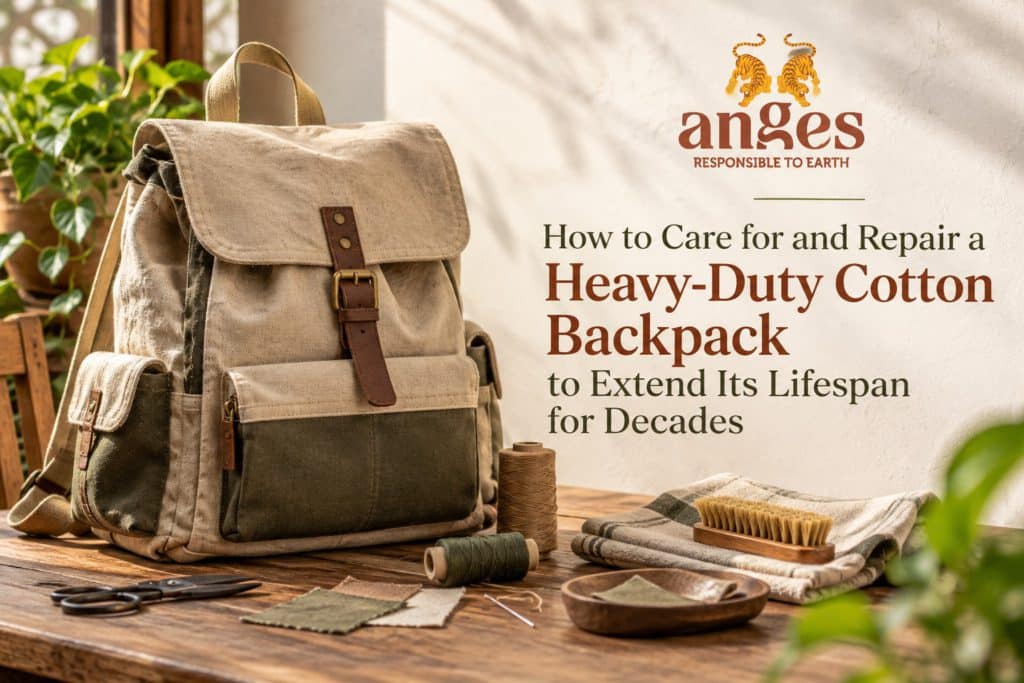
Pick up a backpack that someone has thrown away and look at it closely. Most of the time the canvas is fine. One strap anchor has pulled through half its stitches, one zipper has opened up behind the slider, one bottom corner has worn to the weave. Those three spots, and not the fabric, decided that the bag was finished. That is the real case for a heavy-duty Cotton Backpack. Thick woven cotton lets you get at the damage. You can unpick a seam, lay a patch, swap a slider and re-stitch a strap with a needle, some thread and an evening. Bags with bonded seams and laminated panels rarely allow that, so the same small failure sends them to landfill. Anges makes more than 48 million bags a year for buyers in over 64 countries, and the weak points repeat with a dull regularity from one order to the next. This guide is organised around those weak points, in roughly the order they fail, and around the repairs that hold up under daily use. Where the Load Goes, and Where the Bag Gives Way A loaded backpack pulls down on two strap anchors and the top handle. Everything in the bag hangs from a few centimetres of stitching in each place. The canvas beside that stitching is carrying almost nothing, because the thread takes the strain first. Stress also piles up where a line of stitching ends. The last few needle holes carry a disproportionate share, and that is where a seam usually starts to unzip. This explains why a strap can hold for two years and then go in an afternoon. The first stitches gave up quietly, and each failure handed more load to the next. Bottom corners fail for a different reason. Nothing is being pulled. The bag is simply set down on floors several times a day, and the yarns at the corner lose a fraction of their thickness each time. Zippers wear from the inside out, since grit sits in the slider and polishes it smooth. The fabric itself comes last, usually after years of sun or repeated damp. If you only have time for one habit, make it a monthly tug on each strap near its anchor, then a look along the base seam. Ten minutes of re-stitching at that point saves the afternoon it takes once a strap has torn out with a piece of canvas attached. Let the Thread Be the Weak Link Many people assume the strongest possible thread is best. On a bag you plan to keep for years, the opposite logic is sounder. If the thread is stronger than the canvas, an overloaded seam won’t open. The canvas will rip beside it, and a rip in cloth is far harder to fix than a run of loosened stitches. If the thread is well matched to the fabric, or a little weaker, an accident costs you a seam you can re-sew in fifteen minutes. In effect the stitching acts as a fuse. For most bag canvas that means bonded polyester or nylon in the Tex 70 to Tex 90 range (often sold as size 69 or 92). Polyester holds up better in sunlight, so it suits a bag that lives outdoors. Nylon is slightly stronger but degrades faster under ultraviolet light. Avoid cotton thread on a bag that might get damp, because the same mildew that attacks canvas eats cotton thread first. Read the Canvas Before You Repair It Canvas is usually sold by weight in ounces per square yard, and one ounce works out to about 34 GSM. Canvas weight Approximate GSM Typical use 10 oz 340 Tote bodies, light daily bags 12 oz 407 General-purpose backpacks 15 oz 509 Work bags, heavy-duty packs 18 oz 610 Tool bags, field carry The number matters for repairs because a patch should be close to the weight of the bag. A thin patch on a heavy bag stretches at a different rate from the cloth around it, so it puckers and works loose at the edges. Canvas is a plain-weave fabric traditionally made from cotton or linen, and its long use in tents, sails and workwear tells you it tolerates punishment. Find out whether the bag is waxed. Waxed canvas repels water, can’t be machine washed, and resists most adhesives. Unwaxed canvas is more forgiving to clean and easier to patch. The advice below flags where they differ. Water, Sun and the Mildew Problem A common belief holds that getting cotton wet weakens it. It doesn’t. Cotton fibre is a little stronger wet than dry, which is why sailcloth was made from it. What harms a Cotton Backpack is staying damp. After rain, empty the bag, open every pocket and let it dry at room temperature. Keep it away from radiators, which can stiffen and shrink the cloth, and out of hard direct sun. A bag stored damp will grow mildew. You will smell it first, then see grey or black speckling, and the fibres slowly lose strength. Owners often put this down to age, which is why so many bags seem to fade suddenly after one wet season in a cupboard. Ultraviolet light is the other slow enemy. Dyed canvas fades, and cotton fibre degrades over years of exposure. A bag hung on a balcony hook every summer, or left on a car parcel shelf, ages faster than one kept indoors. Washing: Less Than You Think Every full wash removes some of the sizing that gives new canvas its body, and every machine cycle puts a strain on stitching and hardware. For a bag in daily use, one or two full washes a year is plenty. Spot cleaning and brushing can cover the rest. Start with the dry methods. Turn the pockets out and shake them. Run a brush or a vacuum attachment along the inside seams, where crumbs collect. Let mud dry completely before brushing it away, since rubbing wet mud into canvas sets it. For marks, use
How a Global Jute Bag Manufacturer Navigates EU PPWR Packaging Compliance for International Importers
Waste generated from packaging throughout the EU have reached approximately 186.5 kgs per person in the year 2022, as reported in European Commission’s own figures and the number is still counting. The EU brought some resolutions like The packaging and Packaging Waste Regulation, Regulation(EU) 2025/40. It started operating in February 2025 and it legally binds all its 27 members from 12th August, 2025 into mutual obligations. It applies in the same way in Berlin, as it did with Lisbon with no scope for a country to create its own more softer version of the same. For an importer, that single fact changes how a supplier conversation should go. Asking “is this eco-friendly?” doesn’t tell you much anymore. What you need to know is who is legally on the hook, what paperwork has to travel with the container, and whether the factory on the other end has actually built compliance into how it works, rather than added a line to a product page. We’ve spent years supplying jute and cotton packaging into Europe as a jute bag manufacturer, and this piece walks through what PPWR means for natural-fibre packaging specifically, not the regulation in the abstract, but the parts that show up on a purchase order. From a Patchwork of National Rules to One EU Regulation Before PPWR, packaging law in the EU ran through a directive from 1994, and directives leave room for national interpretation. Germany’s implementation didn’t line up neatly with France’s. A label that satisfied one customs office could get questioned at another. For a business shipping into three or four EU markets at once, that inconsistency was less a legal footnote than a genuine operational cost. PPWR closes that gap by being a regulation rather than a directive, which means it applies directly and identically in every member state without a transposition step. Manufacturers, importers, distributors, and online marketplaces are reading the same text, and it covers packaging from design through disposal: what it’s made from, how much of it is needed, how it’s labelled, and what happens once it becomes waste. Who Counts as the “Producer” — And Why That’s the Question That Matters Most of the confusion we hear from EU clients isn’t about material specifications. It’s about who is legally responsible for what. PPWR builds its obligations around the idea of a “producer”: whoever first places the packaging on a given national market. If a factory in India ships jute bags directly to an importer’s warehouse in Rotterdam, the importer is usually the one who becomes the producer for that shipment under Article 18, taking on registration, EPR reporting, and volume declarations in the destination country. In Germany, for instance, that means registering in the LUCID register run by the ZSVR; other member states run their own national equivalents. The picture shifts if the overseas manufacturer sells directly to EU consumers, through its own site or a marketplace listing. In that case the manufacturer typically becomes the producer, and Article 17 gives it the option (not, notably, an obligation in every case) to appoint an EU-based Authorised Representative to handle registration and reporting on its behalf. Where the manufacturer sells directly to end users without one, Article 45 and the related provisions of the Waste Framework Directive can make appointing a representative mandatory rather than optional, depending on the sales channel. A few duties don’t move regardless of who holds “producer” status: We put these responsibilities in writing with every EU client before the first container leaves the factory. Sorting it out on a customs query is a far worse time to discover a gap. Roles and Responsibilities at a Glance Role Core Responsibility Relevant Provision Manufacturer Design compliance, substance restrictions, technical file, Declaration of Conformity Articles 5–12 EU Importer Verifies manufacturer documentation, often registers as producer, EPR reporting Article 18 Authorised Representative Registration and reporting for non-EU producers selling direct to consumers Article 17 / Article 45 Distributor Confirms upstream compliance before making packaging available Article 19 Where Jute Already Meets the Bar, and Where It Doesn’t Most PPWR explainers are written with plastics manufacturers in mind, and natural fibre gets a paragraph near the end, almost as an afterthought. That framing has it backwards. Jute wasn’t redesigned to satisfy a circular economy regulation; it has been circular packaging since long before the term existed. It’s plant-based, compostable at end of life, and absorbs more carbon across its growing cycle than it releases in processing. As it is not plastic, it avoided two strictest plastic centric obligations in this regulation., it is to use minimum usage of plastics or reusable plastic to minimum for plastic packaging and PFAS restrictions apply mostly to food contact plastic packages from August 2026. That head start doesn’t mean the material is waved through. PPWR applies by function, not by material, so a jute bag still has to satisfy the general rules on substances of concern, packaging minimisation, and, once the relevant implementing acts are finalised, the harmonised labelling requirements expected from around August 2028. Those labels will need to show material composition and correct disposal method using standardised EU pictograms, and reusable packaging entering a formal reuse system will need its own reusability mark, sometimes with a QR code linking to collection information. The mistake we see most often isn’t ignorance of the regulation. It’s a supplier telling a buyer “it’s natural, so it’s compliant” and the buyer taking that at face value. Jute usually clears the substance and design requirements without much friction, dyes and coatings being the main exception worth checking closely, but “usually easier” and “documented” are two different things, and only one of them holds up under an audit. The Paper Trail an Importer Should Ask For A shipment either clears smoothly or sits in a bonded warehouse waiting on someone to produce a document that should have existed from day one. From a jute bag manufacturer that has actually built PPWR into its production process, an EU importer should expect to
Architecting Reinforced Handles and Custom Pocket Layouts in B2B Custom Jute Bags
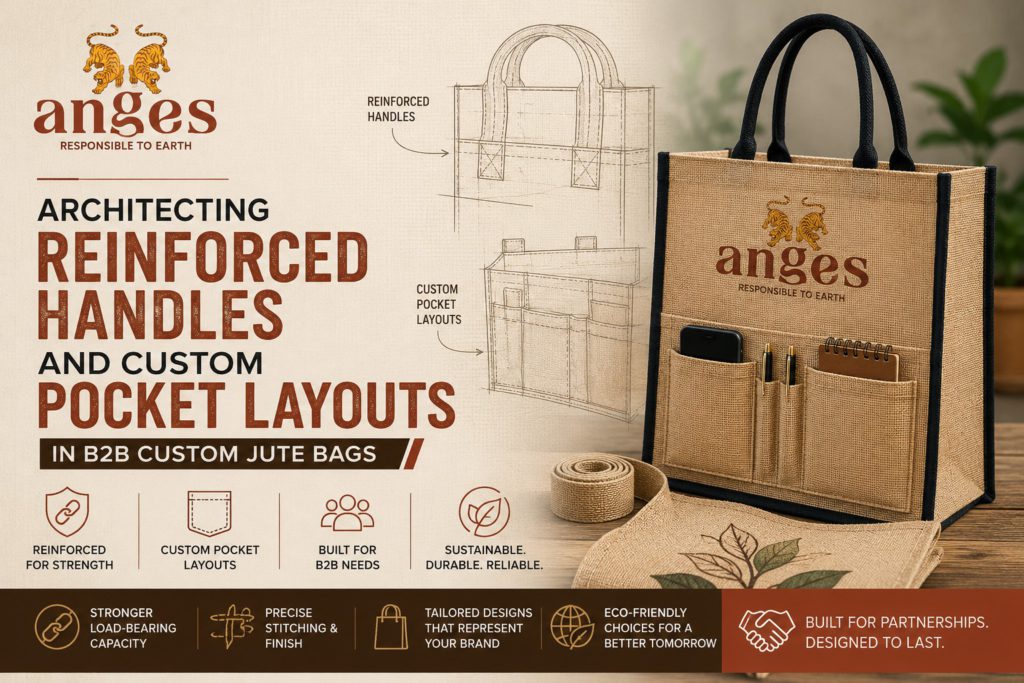
A client once sent us photos of 40 handles, all pulled loose at the same seam, all from the same 3,000-unit batch. Different manufacturer, different order, before they came to us. The stitching wasn’t wrong exactly — it was a straight lockstitch, done cleanly. It just wasn’t built for what the bag was actually going to carry: bottled sauces, lifted daily, by hand, out of a retail display. That’s the gap this guide is written to close. Handle failure on jute orders is almost never a sewing-quality problem. It’s a specification problem — nobody defined the load before the pattern was cut. At Anges Bags, we manufacture custom jute bags for retail, corporate gifting, and export clients, and the handle-and-pocket brief is the one part of the design process that gets rushed most often. Colors, print, and branding get weeks of back-and-forth. Stitch pattern gets a nod and a “looks fine.” This piece is written for the people who sign off on that nod — procurement leads, brand managers, sustainability teams — so the next sign-off is an informed one. Where Handle Failure Actually Starts Handles don’t fail because thread snaps. They fail because a stitch line was asked to do a job it wasn’t built for. Picture the mechanics: every lift transfers the bag’s full contents-weight through two small junctions where handle meets body panel. A single straight stitch line concentrates that entire load onto a narrow band of thread, repeatedly, across the life of the bag. Jute fiber is coarser and less forgiving than cotton under that kind of repeated pressure — it frays at the stress point rather than stretching to absorb it, which is part of why the manufacturing literature on reinforced handles treats them as load-bearing structures, not decorative attachments. For a single gift tote, this is a minor annoyance. For a corporate order of a few thousand units, it’s a pattern that surfaces two to three weeks after delivery, once real-world handling has had time to find the weak point — and by then, the fix is a reorder, not a repair. Building a Handle Mount That Holds There are four variables that determine whether a handle mount survives its working life: stitch pattern, corner reinforcement, drop length, and material choice. None of them are exotic. All of them get skipped when a spec sheet just says “reinforced handles” without defining what that means. Stitch pattern. Box stitching — a rectangle of stitching at the attachment point, often crossed with a diagonal X — spreads pulling force across a wider stitched area instead of one line. Bar-tacking, a short dense stitch cluster, gets added at the corners of that box specifically because corners are where stress concentrates first, before the rest of the seam shows any wear. Bag manufacturers building for heavy retail and agricultural loads use exactly this combination — box-X plus corner bar-tacking — for bags rated to carry meaningful weight. Drop length. The distance a handle hangs below the top seam isn’t a style choice, it’s a leverage calculation. A shorter drop puts more strain on the shoulder seam every time the bag is filled and lifted; a longer drop distributes that same force over a wider arc. For grocery-weight loads, we generally spec a longer drop than what looks “correct” in a flat sample photo — because a flat sample is empty, and the bag never will be. Backing panel. This is the detail most buyers never see, because it’s meant to be invisible. An internal reinforcement strip, stitched between the outer jute layer and the base of the handle, takes on the actual load-bearing work so the visible stitching doesn’t have to. We spec this for any order carrying more than light, dry retail goods — grocery items, bottled products, printed materials with real weight. Handle material. Braided jute keeps the aesthetic fully natural and performs fine for gifting and light retail. Cotton webbing or bamboo, stitched into a jute body, holds up better under daily reuse — grocery bags, trade-show giveaways that double as work totes, anything expected to survive more than a few lifts a week. Neither choice is “correct” on its own; it depends on what the bag is going to carry and how often, which is a conversation worth having before the sample stage rather than after a complaint. What Buyers Are Actually Asking For Inside the Bag Something has shifted in what corporate buyers request for promotional and gifting bags. Two years ago, most briefs asked for a single open compartment. Now, a meaningful share of the briefs we receive specify internal organization — a slip pocket, a divider, somewhere to put a phone or a card that isn’t loose against the bottom of the bag. The current promotional bag market reflects the same shift: multi-compartment interiors are moving from a premium feature to something closer to a baseline expectation, because a bag with somewhere to put things gets used again; a bag that’s just an open sack gets folded into a drawer. Jute complicates pocket design in a way canvas doesn’t. Canvas drapes and folds; jute holds its shape and resists tight folding. A pocket layout copied directly from a cotton tote spec sheet can sit stiff or restrict access on a jute body if nobody adjusts for that difference. Placement That Works With the Fabric, Not Against It Interior slip pockets, stitched to the side panel, hold a phone or a small branded insert without interfering with how the bag folds flat for shipping — which matters more for jute than for softer fabrics, since a stiff bag with a poorly placed pocket won’t fold at all. Center divider pockets suit corporate gifting kits that need two distinct compartments — one for a physical item, one for a card or printed insert. This works because the divider itself adds structure, which plays to jute’s natural stiffness instead of fighting it. Exterior utility pockets make sense only when the bag is meant
Jute Bag Manufacturer & Shopping Bags Manufacturer for Corporate and Decorative Jute Bags
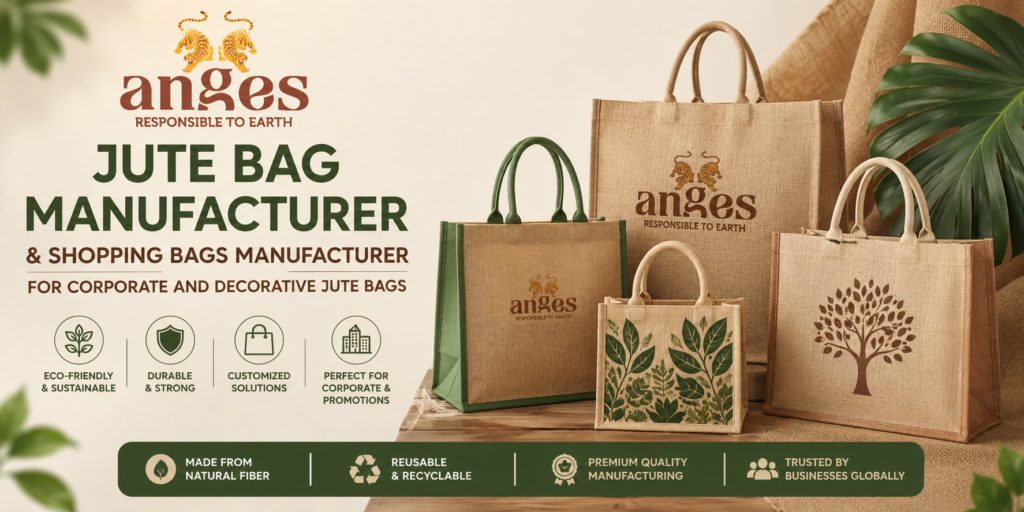
If you’re a business owner, retailer, or procurement manager searching for a dependable jute bag manufacturer, you already know the struggle. Generic ready made bags rarely fit your brand, your budget, or your bulk order timelines. What most businesses actually need is a manufacturing partner who can produce jute bags to their exact specifications, at scale, with consistent quality every single time. This guide walks you through everything you need to know before placing an order with a jute bag manufacturer company — from what to look for, to the types of bags available, to how the ordering process actually works. Why Choose a Professional Jute Bag Manufacturer? There’s a big difference between picking up a handful of jute bags from a local wholesaler and working with an actual jute bag manufacturer. When you buy off the shelf, you’re stuck with whatever size, colour, and finish is already on the shelf. There’s no room to add your logo properly, no consistency across bulk quantities, and often no accountability if the quality drops halfway through your order. A professional manufacturer works differently. They control the process from raw material selection to final packaging, which means: For businesses, exporters, retailers, and event organizers, this control over the manufacturing process is what actually protects your brand image and your budget. What Makes a Reliable Jute Bag Manufacturer Company? Not every manufacturer that claims to make jute bags is equipped to handle serious B2B orders. Before you commit, it helps to know what separates a dependable jute bag manufacturer company from one that will leave you with delayed deliveries and inconsistent quality. Here’s a practical checklist to evaluate any manufacturer you’re considering: Running through this list before you place an order saves you from costly reprints, missed deadlines, and brand inconsistency later. Custom Jute Shopping Bags for Retail and Business Use If you run a store, boutique, supermarket, or exhibition stall, your shopping bags are doing more marketing work than most people realize. Every customer who walks out with your bag is carrying your brand through the street, literally. A capable shopping bags manufacturer can build jute shopping bags around your actual retail needs: Retailers who invest in well made, properly branded jute shopping bags often find they double as free advertising — customers reuse them for groceries, travel, or daily errands, which keeps your brand visible long after the sale is made. Corporate Jute Bags Manufacturer for Branded Business Requirements Corporate buyers have a different set of priorities than retail buyers — consistency, professional finishing, and brand accuracy usually matter more than anything else. A dependable corporate jute bags manufacturer understands this and builds accordingly. Corporate jute bags are commonly used for: For all of these use cases, the details matter more than they might seem to. Logo placement needs to be precise and legible. Brand colours need to be matched accurately, not approximated. Finishing needs to look premium enough to represent the company, not like an afterthought gift. And most importantly, quality has to be consistent whether the order is for 200 bags or 20,000 — because a corporate gift that falls apart undermines the exact impression the business was trying to create. Decorative Jute Bags Manufacturer for Gifting and Special Occasions Jute isn’t just functional — in the right hands, it becomes genuinely decorative. A skilled decorative jute bags manufacturer can turn a plain jute bag into something that feels premium enough for gifting, without straying from what a manufacturer can realistically and consistently produce at scale. Decorative jute bags are commonly used for: Customization options for decorative bags typically include prints and patterns, embellishments like ribbons or tassels, coloured linings, embroidered detailing, and premium finishing touches — all of which can be adjusted based on the occasion and the budget, while keeping the manufacturing process practical and repeatable. Types of Jute Bags a Manufacturer Can Produce Before placing an order, it helps to know the general categories a manufacturer typically works with. This gives you a clearer starting point when describing your requirement. Jute Shopping Bags Built for everyday retail and grocery use. These focus on functionality — sturdy handles, reasonable load capacity, and a size that’s easy to carry. Branding is usually simple and clean. Corporate and Promotional Jute Bags Designed with brand consistency in mind. These are built for events, conferences, and campaigns where the bag represents the company, so finishing and print accuracy are prioritized. Decorative and Gift Jute Bags Focused on appearance and presentation. These bags are used where the “unboxing” or gifting moment matters as much as the bag’s function. Custom Printed Jute Bags Centered around branding and personalization — logo printing, custom artwork, and specific colour matching across any of the categories above. Customization Options Available from a Jute Bag Manufacturer One of the biggest advantages of working with a manufacturer instead of a wholesaler is the level of customization available. Here’s what buyers can typically adjust: A corporate buyer ordering bags for a conference will prioritize different combinations of these than a boutique ordering decorative gift bags — which is exactly why customization matters more than picking from a fixed catalog. How to Choose the Right Jute Bag for Your Business With so many options available, it helps to narrow things down using a few practical questions: Working through these questions before reaching out to a manufacturer makes the entire ordering process faster and more accurate. What to Ask Before Ordering from a Jute Bag Manufacturer Before you place your order, it’s worth asking the manufacturer these direct questions to avoid surprises later: Getting clear answers here upfront prevents miscommunication and protects your launch or event timeline. Why Businesses Prefer Custom Jute Bags for Branding Beyond sustainability, there’s a practical business case for choosing custom jute bags over generic packaging or plastic alternatives: For businesses trying to build recognition without a heavy ad spend, custom jute bags are a low cost, long lasting way to stay visible. How to Place a Bulk
Why HR Departments Love Working with a Corporate Jute Bags Manufacturer for Onboarding
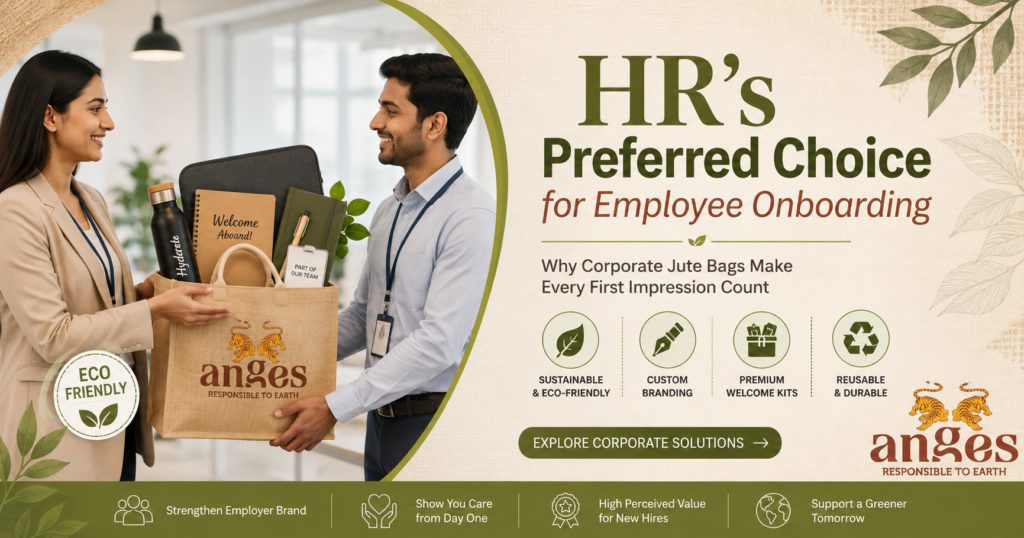
There is something about that first day, isn’t there? You walk in — or these days, maybe you log in — and there is this little welcome pack sitting there. I have seen people’s faces change over something as simple as a bag. A real bag. Not the plastic kind that rips before Friday. HR folks have caught on to this in a big way. Over the years, many of them have started calling us, a Corporate Jute Bags Manufacturer, to put together onboarding kits that actually last. At Anges Bags, we make a lot of bags. North of 48 million every year, shipping out to more than 64 countries. A fair number of those end up with brand-new employees at companies you would recognise. When HR managers sit down with us, it rarely stays about the bag for long. It becomes about what that first impression should feel like. So, let’s get through what we witnessed, if it worked and why the pairing is perfect. The slow, steady turn toward welcome kits that don’t harm the planet A few years ago, I’d watch companies stuff onboarding kits with things destined for the bin. That script has flipped. Deloitte published a 2024 Global Human Capital Trends https://www2.deloitte.com/us/en/insights/focus/human-capital-trends.html piece that made a point — when sustainability seeps into the employee experience, engagement and retention improve. HR leaders read that and ask, where do we begin? Often, the welcome bag is the easiest, most visible starting point. Jute works because it feels honest. Earthy, warm. You drop in a notebook, a reusable bottle, maybe the handbook, and suddenly it’s not a bundle of freebies. It says something without shouting. I’ve had more than one HR manager tell me the bag does half the talking about company values before orientation even kicks off. Why new hires actually keep these bags Truth is, not every bag is cut out for this. HR teams need something that can take a beating. Someone will jam a laptop, gym clothes, and a lunch box in there. We usually nudge them toward laminated jute. It can keep its shape intact, can sustain a small amount of drizzle, and do not look worn out after a week.The other bit? The bag sticks around. Once I saw a person carrying one of our bags with the particular company logo. He has been using it for two years. Still hauling it. That is the kind of brand exposure you cannot pay for. A solid manufacturer helps HR choose the right weight, handle stitching, finish — so that bag earns a spot in someone’s daily rhythm. A real project that stuck with me A while back, a global IT firm got in touch. They were onboarding over 2,000 grads in waves. Their old plastic kits were, to put it kindly, forgettable. The HR director said half the bags didn’t survive a month. We worked with their team, designed a minimal jute backpack — foldable, light, just their purpose statement printed on it. Nothing overdone. Six months later they shared some numbers. Bag usage among new hires was up nearly 40% versus the old plastic stuff. That made the HR team look smart, and it reaffirmed something for us: listening beats fancy design every time. It wasn’t complicated. We just heard what their people would actually carry. Custom touches that feel personal Every company’s culture is its own beast. A startup might want bright colours and a huge logo. A law firm? Probably muted tones, a small debossed crest. We’ve done both. Jute takes screen printing, digital, embroidery surprisingly well, so there’s room to get creative without the budget spiraling. Beyond visuals, you can mess with the function. Padded laptop sleeve, inner pocket, zipper, convertible handles from a Corporate Jute Bags Manufacture. I’ve seen HR teams come to us with a rough sketch on a napkin, and we turn it into a sample. That back-and-forth gives the final bag a sense of belonging — not like it was picked from a catalogue. A bag that lives a life, not dies in a drawer The best feedback we hear: “I’ve had mine for three years.” Jute is just tough. We pull handles and seams in the factory until they fail, so we know the limits. When someone visits a market on his off duty, the logo becomes also part of his personal life which indicates the profession he belongs to. THis is a silent swag which is not hidden during his off duty. Keeping the budget sensible Onboarding budgets rarely have much slack. Cutting out middlemen helps. We price from the factory floor, so per-unit costs stay reasonable even for big orders. A well-made jute bag that lasts two years costs less per impression than a cheap bag swapped out every quarter. The HR folks who run the numbers usually end up pitching it as a clever spend, not a fluffy extra. Deliveries that don’t give HR a headache Onboarding schedules are tight. Kits have to be there on the day, whether at the office or on someone’s doorstep. We’ve shipped to corporate HQs, regional hubs, and straight to home addresses. I remember an HR coordinator onboarding a fully remote cohort during a lockdown. We sent kits to 400 different addresses in a single week, each trackable. She later said it was one fewer thing to panic about. That’s the goal, really. Trust is non-negotiable HR teams take on real risk when they pick a supplier. If a factory has shady practices or can’t back up claims, the company’s name gets dirty. We’ve always been open about our certifications — ISO 9001:2015, SA8000, Sedex member. These are not decorations. They mean auditors show up, check things, and we hand over paperwork when compliance asks. That kind of transparency can shave weeks off the vendor approval timeline. I’ve seen it happen. Tying it to bigger sustainability goals Lots of companies now have public green targets. Onboarding kits can contribute a little. Jute is biodegradable,
Why Trade Shows Are Moving Toward Eco-Friendly Promotional Bags Manufacturer Partners
I’ve been in this bag game longer than I care to admit, and a little scene from a Frankfurt trade show still pops into my head when people ask why things are changing. I was leaning against a pillar near a client’s booth, sipping something lukewarm, just watching the tide of people. Across the way, an exhibitor was enthusiastically pressing these ultra-thin plastic drawstring bags into everyone’s hands. You know the ones — they crinkle, they sweat, and if you drop a heavy catalogue plus a water bottle inside, the seams start screaming. One guy took a bag, loaded it up, took about seven steps, and rip. Stuff all over the floor. He didn’t even look back. Just scooped up his things and vanished into the crowd. That company had spent who knows how much on the booth, the travel, the lights… and a bag worth maybe five cents killed whatever impression they’d made. That moment sort of planted a seed, even though I already worked in sustainable bags. It made me realize the freebie bag isn’t a minor detail. It’s often the first physical thing someone associates with your brand at a show. And these days, with the way attitudes have shifted, that first touch had better feel right. We’ve been seeing it clearly at Anges Bags. Buyers who would’ve called us five years ago just to get the rock-bottom price are now leading with a whole different set of questions. They’re looking for an eco-friendly promotional bags manufacturer that doesn’t just talk a nice game, but can actually prove the bag is what it claims to be, can deliver on time, and can handle quantities that sometimes make logistics people sweat. We’re not a tiny operation — over 48 million bags a year, across 64-plus countries — and even we have to stay on our toes. I’m not sharing theory here. This is stuff I’ve picked up on the floor, on the phone with stressed event managers, and occasionally standing ankle-deep in sample swatches. The Growing Demand for Sustainability at Trade Shows I remember when the brief from most clients was basically “cheapest tote, logo in one color, send it.” That world’s crumbling. Organizers have started pushing, not just gently nudging. UFI, the exhibitions industry body, has data showing that a solid majority of organizers now run some kind of sustainability programme, and a lot of them are turning that into requirements for exhibitors. (Source: [UFI Sustainable Development Report](https://www.ufi.org/industry-resources/sustainability/ )) I’ve heard directly from exhibition managers — one lady in particular who runs a big tech show — that her team actually walks the floor and notes which booths are handing out single-use plastics. If you’re on that list, you might get a polite, but very pointed, email. And honestly, attendees are paying way more attention. They’ll pick the bag up, turn it over, squint at the little label inside. If they’re talking to your sales guy about innovation and responsibility, and the bag in their hand screams disposable, they feel that disconnect. Sometimes they even ask, “Is this recycled?” and you better have an answer ready. Large venues have started banning single-use plastic bags outright too. So if you’re doing a show circuit, finding a dependable promotional bags manufacturer that breathes this sustainability stuff isn’t some optional add-on. It’s just part of getting your booth together. What Makes a Promotional Bag Eco-Friendly? “Eco-friendly” gets slapped on everything, and I’ve seen enough to be a little suspicious when there’s no paperwork behind it. Over time, I’ve boiled it down to three things that actually separate a bag worth the label from one that’s just riding the trend. The raw material itself tells a story. Organic cotton has a soft, almost velvety feel that makes people want to keep it. rPET — basically recycled plastic bottles spun into fabric — is lighter, sleek, and easy to print on. Natural jute has that earthy, rustic vibe. And laminated jute, which we make a ton of, adds a layer that handles moisture and rough treatment. For multi-day indoor shows where people are hauling around heavy magazines, laminated jute is a quiet hero. For a luxe product launch, cotton canvas just feels richer. Certifications are the proof part. GOTS for organic cotton, OEKO-TEX for safety. I always tell clients, ask to see the actual certificate. If the supplier stumbles or says they’ll send it later and never does, that’s your cue to leave. We’ve had nothing to hide, so handing over documents is just part of our process. And then the afterlife of the bag. An eco-friendly promotional bag that gets used once and tossed is a fail. A good one lives on. I’ve had clients send me phone snaps of our bags at grocery stores, at yoga class, at a beach, even tied to a motorcycle. That’s reuse happening in the wild. Picking an promotional bags manufacturer means finding someone who talks about these layers without making it sound like a script. Why Trade Shows Are Choosing Sustainable Promotional Bag Partners It’s not just guilt or fear of getting shamed. Some of the savviest event folks I’ve dealt with see this as a quiet brand flex. Brand alignment is a big one. If your whole pitch is about caring for the future, handing over a flimsy plastic sack is like ending a heartfelt speech with a kazoo solo. I worked with a tech company that made a big deal about reducing e-waste. They gave out recycled-material bags at their booth, and attendees actually asked about the bag’s story, which opened the door to talk about their mission. That wouldn’t have happened with a generic throwaway. The sensory thing matters too. A bag that feels substantial, that sits comfortably on your shoulder, that has a bit of texture — people hold onto it. They repurpose it. Every time they do, your logo is riding along. It’s the quietest, cheapest impression you’ll ever buy if you get the quality right. Compliance is
Sustainable Sophistication: The Future of the Corporate Jute Bags Manufacturer
Plastic has finally started to stink in the corporate world Not the smell of it. The reputation. Walk into any boardroom or trade show floor and the giveaway pile is a graveyard of cheap ballpoints, keychains that break before the conference ends, and shiny totes that nobody wants to be seen carrying outside the venue. That whole model is dying. And the thing pushing it off the cliff is something that looks like it belongs in a farmer’s market but feels like it belongs in a boutique hotel lobby. A jute bag. Except not the rough scratchy one you remember from the 1990s. Something else entirely. What even is a corporate jute bag supposed to mean right now Right now it means the company giving it to you actually read the memo. The memo that said regulators are tightening, plastic bans are spreading, and the next generation of talent and clients isn’t asking whether you have an ESG policy. They’re checking if your merch matches it. A Corporate Jute Bags Manufacturer isn’t just pushing out a natural-fiber container anymore. The gig has changed. It’s about manufacturing proof. Proof that the brand in question is willing to spend money on something that rots safely into soil instead of outliving the recipient in a landfill. That’s a heavy burden for a bag. But jute can carry it. Literally and metaphorically. Why jute doesn’t need a greenwashing filter This is the part that procurement officers like. Jute is a rain-fed crop. No irrigation drama. Minimal pesticides. It sucks carbon out of the air faster than most trees and when its life as a conference bag ends it breaks down completely. A Jute Bags Manufacturer doesn’t have to invent a sustainability story. It just has to tell the one that already exists in the fiber. That’s rare. Cotton needs enormous water. Recycled polyester still sheds microplastics. Jute basically walks in and says, “I’m fine. No fine print needed.” And because the story is so clean, the bag becomes a quiet handshake. No screaming logos. No neon colors trying to be memorable. Just a piece of material that feels deliberate. The rough fiber that learned to dress up The old headache about jute was the texture. Too coarse. Shedding fibers on a black suit. Nobody wants to reach into a gift bag and pull out a handful of slivers. That’s changed. Modern finishing has turned jute fabric into something that can hold its own next to canvas and linen. A jute bag production house now works with softened weaves, laminated interiors, precision stitching. The bag can be dyed a deep charcoal or navy that doesn’t look like a school project. Handles are reinforced. Sometimes there’s leather trim. Sometimes a minimalist debossed logo that you notice on the third glance. That’s the sophistication part. It doesn’t shout. It sits on a meeting room chair and just looks right. Why a cheap gift now costs more than an expensive one Nobody says it out loud at the procurement meeting but it’s true. A plastic folder with a sticker on it gets thrown away. A poorly made jute bag might last six months. But a good one, a bag from a Jute Bags Manufacturer that actually understands stitching and load-bearing and how a strap feels on a shoulder after two hours of walking an expo hall, that bag stays. It becomes the thing the recipient uses to carry their lunch. Or their gym kit. Or their laptop to a coworking space. Every day that bag is in public, it’s advertising. And not the kind that begs for attention. The kind that says, “This company gave me something I didn’t want to bin.” That’s the return on investment no spreadsheet captures properly. Long-haul brand visibility wrapped in a fiber that degrades gracefully. The logo that whispers instead of yells Luxury went quiet. The branding trend that matters right now isn’t about being bigger. It’s about being subtler. A tonal print on a natural jute surface. A small leather patch. An inside label with a message about reforestation or farmer welfare. A Corporate Manufacturer that gets this is essentially making editorial merchandise. Stuff that belongs in a magazine spread about conscious living, not in a bottom drawer with dried-out highlighters. Anges Bags sits in that space. Not as a mass producer of generic sacks but as a specialist that can execute a design language a brand manager actually feels proud to put in a welcome kit. When the bag looks like something you’d buy in a design store, the recipient forgets it was corporate merch. That mental shift is priceless. Supply chains with receipts not just promises There’s a quiet panic happening in corporate responsibility departments. New regulations are demanding traceability. “Sustainably made” without evidence is becoming a liability. A jute bags manufacturer with a transparent chain from farm to finished product solves that headache. The fiber comes from a place. The weaving happens somewhere. The stitching is done under conditions that can be audited. That string of proof is now more valuable than the bag itself for a company preparing its annual sustainability report. It turns a simple promotional item into a compliance asset. Not many swag items can do that. A plastic water bottle certainly can’t. What happens when the bag gets tired Everything gets tired eventually. The difference with jute is that tired doesn’t mean toxic. It goes into the ground and improves soil structure as it decomposes. A product whose end-of-life actually feeds something instead of poisoning something. That’s the circular logic a Manufacturer bakes into every unit. It’s a conversation ender in the best way. When a board member asks, “And what happens after use?” the answer isn’t a mumble. It’s a clear biological loop. The dull edge of the competition Everyone else is still pushing polyester. Or cotton blends that guzzled water in drought-prone regions. Or bamboo that required chemical processing to become fabric. Those products are going to hit walls. Not just
The Perfect Travel Companion: Designs from a Cosmetic Bags Manufacturer
I’ve been sitting here trying to remember the exact moment I decided that a toiletry bag actually matters. Not the kind of thing you plan to care about, is it. But I was in a cramped bathroom in Porto, the kind where the shower is basically a wet corner and there’s nowhere to put anything except the floor. I had this cheap pouch, the sort you grab at a pharmacy last minute, and the zip just gave out. Not slowly, not gracefully. Just split right open, toothpaste and face wash and a tiny bottle of something expensive all rolling across the damp tiles. I was there, and thought that people who are behind designing these things are into something. Why I started paying attention to who actually makes the bag It’s strange, the stuff we drag around with us. I never care about a general bag manufacturing company with the one cosmetic bags manufacturer. A friend showed me the difference in the zipper , inside lining and fabric. That’s where they give themselves away. A lot of brands, they’ll put a pretty exterior on a bag and call it a day.. When looking inside, you can see a thin absorbed layer which is caused by a stain from a shampoo cap not closed properly. The graveyard of failed pouches I kept for no reason I’ve gone through a small graveyard of these things. The waxed canvas one that smelled weird after two days in Bali. The transparent plastic one that cracked along the fold line on a cold flight to Chicago. The one with no internal pockets where everything just became a soup of lids and stray cotton buds. I can’t say it was easy to connect the dots. Each failure was just annoying enough to make me sigh, but not quite annoying enough to make me research who actually knows how to build one properly. It changed when I started travelling a lot for work. Maybe sometimes three cities in a week, and when you travel this lot, there will be some imperfections in packing your essentials. It becomes almost personal. Finding a maker that only does one thing What I eventually found, after way too many hours reading reviews and old forum posts, was that the good ones nearly always trace back to a cosmetic bags manufacturer that doesn’t make anything else. No luggage, no backpacks, no wallets. Just toiletry bags and maybe some organisers. Anges bags came up in a thread about leak-proof cases for humid weather. Someone described how the elastic loops inside held her serum bottles firmly, even when the bag was tossed around in the back of a dusty car. That detail stuck with me because I’d lost a bottle of expensive Vitamin C stuff on a bumpy jeep ride in Mexico. It had uncapped itself and ruined a linen shirt I loved. Unboxing and the immediate checks I now do So I tried one. I didn’t expect much. I am not essentially a brand obsessed person, but I remember unboxing it and feeling the inside seams. They were taped. The fabric wasn’t that cheap, shiny stuff. It felt almost like a soft canvas but clearly synthetic, water resistant. The zipper pull was a chunky cord, easy to grab when your hands are wet. That night, I loaded it up with everything I owned, hung it on a door hook, and just unzipped it a few times. It didn’t snag. Not once. I felt a little ridiculous testing a bag like that, but there it was. What a specialist gets right that others don’t I think the thing that separates a specialist bags manufacturer from the rest is how little they expect you to forgive. A cheap bag demands that you overlook things. Oh, the hook is a bit flimsy but it works if you don’t put shampoo in it. Oh, the lining absorbs water but you can dry it out in the sun. A bag from Anges bags, on the other hand, sort of dares you to find a flaw. I’ve been looking. I’ve taken it to steamy coastal towns, high-altitude places where stuff expands and leaks, and shoved it into carry-ons that were definitely overstuffed. The thing just… copes. The zippers stay aligned. The hook was not bent, not even slightly, the lining can be cleaned with a single wipe of a damp cloth and it also dries very quickly. Sustainability that speak itself I read somewhere, maybe on Travel + Leisure, that travellers are getting more serious about longevity and materials. (source: https://www.travelandleisure.com/style/travel-accessories/eco-friendly-travel-products ) The article talked about people wanting less throwaway stuff, more things built to last. That idea resonated. I don’t want to buy a new toiletry bag every year. I don’t want to bin something just because the stitching frayed. Anges bags seems to get that. It’s not loudly claiming to save the planet, but the bag feels like it’ll outlast my enthusiasm for most things. That’s its own kind of sustainability, I suppose. Quiet and functional. How packing finally became a calm little ritual Here’s a small thing I’ve noticed. When I’m packing now, I look forward to the toiletry section. It used to be the bit I dreaded, because I knew something would go wrong. Now I just roll my bottles into the loops, zip the mesh pocket closed over my toothbrush and razor, and fold the whole thing into my case. There’s no anxiety. That tiny lack of friction has spread to the rest of my packing routine in a way I didn’t expect. It’s silly, but when you’re standing in a foreign bathroom at 6am trying to get ready for a meeting, not having to hunt for a misplaced comb or mop up a puddle of toner feels like a genuine gift. The quiet truth about a good toiletry bag I’m not saying a bag from a skilled cosmetic bags manufacturer will fix your travel life. You’ll still forget your charger sometimes, and