
The Lifecycle Cost Analysis: Why Jute Shopping Bags Outshine Single-Use Paper and Poly Bags
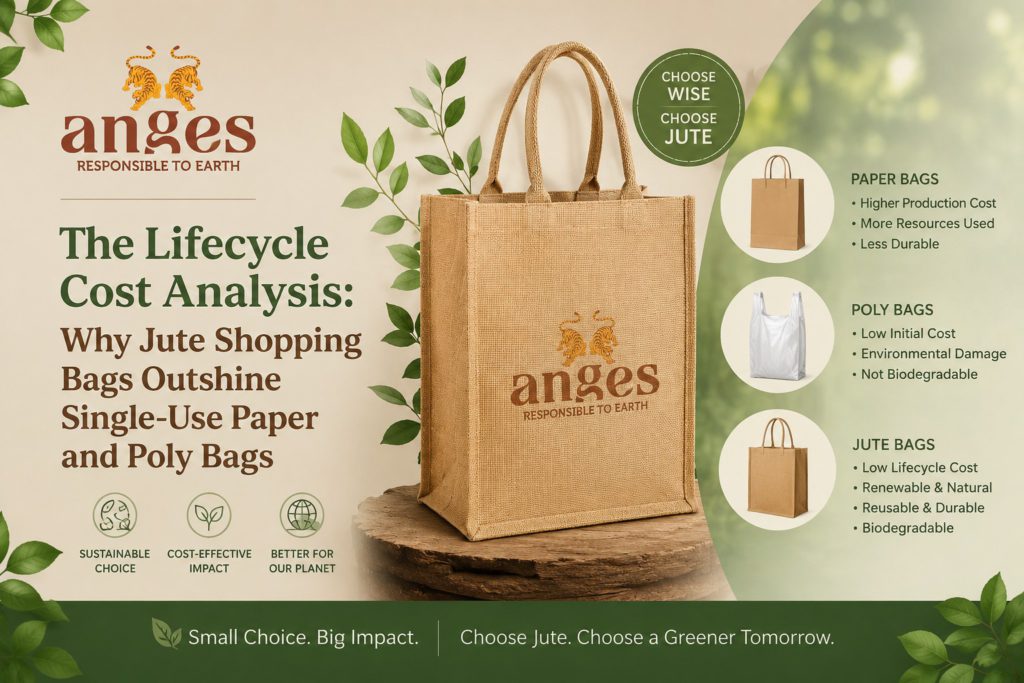
Most packaging comparisons stop at a single line: price per bag. That number is easy to put in a quotation and easy to compare across suppliers, which is exactly why it gets treated as the whole answer. It isn’t. A price-per-bag comparison only tells you what something costs the first time it’s used — it says nothing about the tenth time, or whether there is a tenth time at all. That gap matters more than it used to. Many retailers who moved off thin plastic bags after India’s 2022 carry-bag restrictions defaulted to paper as the obvious substitute, without running the second calculation: how many times does a paper bag actually survive being used before it’s discarded, and what does that do to the real cost per transaction once you account for the replacements? We manufacture jute shopping bags at Anges Bags — laminated, printed, plain, gusseted, in volumes that run into the tens of millions annually across export and domestic orders. This piece isn’t a general sustainability pitch. It’s the arithmetic we walk clients through when they’re deciding what to put at their checkout counter. The Number Everyone Compares, and Why It’s the Wrong One Procurement teams almost always start with price per unit. It’s the number on the quotation, so it’s the number that gets compared. Industrial-grade jute shopping bags in India currently run roughly ₹57 to ₹130 per piece depending on weight, size, and finish, according to current wholesale listings on trade platforms like TradeIndia. A basic poly bag can cost a fraction of that. Compared side by side on that one line, jute loses every time. But a poly bag is engineered to survive one trip from the till to the car. A jute bag, especially a laminated one with reinforced box-stitched handles, is engineered to survive hundreds of trips.. If you want to compare the difference in pricing on both items, it is like comparing a cab fare with buying a car. So technically if it is the price you are concerned about, it is not a fair comparison. The number that actually matters is cost per use: unit price divided by the number of times the bag gets used before it’s discarded. Paper and Poly: Cheap Once, Then Gone Paper bags cost more to produce than plastic ones — industry pricing puts paper bags anywhere from roughly $0.05 to $0.25 per piece globally, against $0.01 to $0.05 for plastic, driven mostly by the raw material and processing involved in paper manufacturing. That gap alone should tell you something: paper isn’t winning on cost, it’s winning on optics, because it looks more “natural” at the counter even though it’s still a one-trip product in most retail settings. Unlined paper bags have a known weak point: anything with moisture — vegetables, dairy, an oil bottle — puts stress on the wet paper fibers at the seams, and eastern India’s humidity for most of the year doesn’t help. Reinforced or laminated paper bags hold up better against this, but they cost more, which erodes the “paper is the affordable eco option” argument even further. Poly bags under 120 microns have been banned in India since December 2022, and the compliance environment has only tightened since. Even where thicker, technically legal poly bags are still used, they’re a single-use product in practice — nobody is reusing a checkout poly bag fifty times. Whatever the sticker price, it’s a price paid once per bag, every time. Jute: The Bag That’s Supposed to Come Back We don’t sell jute shopping bags as reusable in a marketing sense. We build them to be reused because that’s the only way the fiber and the construction make sense economically. A laminated jute bag with box-corner stitching, used the way most Indian households use a grocery tote — weekly market runs, the odd trip to carry books or gifts — will typically hold up for a year to two years of regular use before the seams or lamination start to give out. We’re not claiming an exact number of uses, because it depends heavily on load weight and how the bag is stored between uses. Even a tight number of using it 100 to 150 times also can change the calculation overall. Lets calculate, if we take the upper limit of the jute price range, ₹130 and divide it with 100 times of usages. That’s ₹1.30 per use — below what most retailers pay per poly bag today, and a fraction of what reinforced paper costs per single use. The point isn’t that jute is “eco-friendly,” even though it is. The point is that when you actually run the division, jute is the cheaper option per transaction, not the more expensive one. Most procurement conversations never get to that division because they stop at the invoice line. The Regulatory Backdrop Isn’t Static India’s plastic carry bag rules have moved in one direction since 2022: tighter. Bags below 120 microns are banned nationwide, and since mid-2025 all plastic packaging — carry bags included — must carry a QR code or barcode for traceability. Penalties for violations can run to a lakh in fines or, for repeat and serious offenses, imprisonment under the Environment (Protection) Act. This isn’t unique to India. According to the United Nations Environment Programme, the number of countries restricting single-use plastic bags grew from 91 in 2018 to more than 127 by early 2026. That’s not a regional trend businesses can wait out — it’s the direction global packaging regulation is heading, and India’s rules track fairly closely with it. None of this changes the cost-per-use math directly. What it does is add a second cost to plastic that doesn’t show up on the manufacturer’s invoice: audit risk, inspection exposure, and the possibility of a fine that dwarfs anything saved on bag pricing. A business still relying on non-compliant poly bags in 2026 isn’t just paying more per use — it’s carrying legal exposure most procurement spreadsheets don’t have a line
Jute Bag Manufacturer Company: Complete Guide to Jute & Cotton Bags in 2026
Plastic is finally losing its grip on the packaging world, and buyers everywhere are on the hunt for something that actually lasts, looks good, and doesn’t leave a mess behind for the next generation. That shift is exactly why more businesses are dropping single use plastic bags in favour of jute and cotton alternatives — and why the search for a dependable jute bag manufacturer company has become so common among retailers, gifting brands, and event planners alike. Jute and cotton bags aren’t a passing trend. They’re sturdy, reusable, and genuinely eco friendly, which makes them a smart long term investment rather than a one time purchase. But not every manufacturer delivers the same quality, and picking the wrong one can mean weak stitching, inconsistent printing, or bags that fall apart after a few uses. This guide walks you through everything you need to know before you place your next order — from the different types of jute bags and cotton bags available, to how you can tell a serious manufacturer apart from a hit or miss supplier. Introduction Consumers today are paying closer attention to what they carry home from the store. Reusable, biodegradable packaging has gone from a “nice to have” to something customers actively look for, and many state and local governments have tightened restrictions on single use plastic bags to speed that shift along. For businesses, this changes the packaging conversation. A shopping bag isn’t just something to carry goods in anymore — it’s a small, walking advertisement for your brand every time a customer steps outside with it. That’s precisely why the manufacturer you choose matters so much. The right partner gives you consistent quality, dependable delivery timelines, and bags that hold up to daily use. The wrong one can quietly damage your brand reputation with every torn handle or faded logo. By the end of this guide, you’ll understand the different jute and cotton bag options on the market, what separates a reliable jute bag manufacturer company from an average one, and how to decide which fabric fits your business needs best. Why Businesses Are Choosing Jute and Cotton Bags in 2026 Sustainability isn’t a marketing checkbox anymore — it’s become part of how customers judge a brand before they even walk through the door. Companies that switch to reusable jute or cotton packaging send a clear, visible signal that they care about more than just the sale. There’s also a practical branding upside. A well printed jute or cotton bag turns into free advertising the moment a customer carries it out in public, at a market, or even years later at the grocery store. Add in growing corporate responsibility commitments and a genuine consumer preference for products that don’t end up in a landfill within a week, and it’s easy to see why so many businesses are rethinking their packaging strategy this year. Benefits of Jute Bags Jute has earned its reputation as one of the toughest natural fibres in the packaging world, and it comes with a few standout advantages: A well made jute bag can genuinely outlast dozens of plastic bags, which is part of why it’s become the go to choice for grocery chains and gifting brands alike. Benefits of Cotton Bags Cotton brings a different set of strengths to the table, and it’s often the preferred pick when a softer, more polished look is the priority: Where jute leans rustic and rugged, cotton leans clean and refined — which is why many businesses end up stocking both. Understanding Different Types of Jute Bags Not all jute bags serve the same purpose. Here’s a breakdown of the main categories you’ll come across while sourcing from a manufacturer. Jute Shopping Bags Jute shopping bags are the workhorse of the lineup — built for grocery stores, retail counters, and everyday errands. They’re designed to handle repeated trips, heavier loads, and daily wear without losing their shape, which makes them a natural replacement for plastic carry bags at checkout counters. Jute Gift Bags When presentation matters, jute gift bags step in. Their natural texture already looks festive, which makes them a favourite for weddings, festivals, and corporate gifting. Many businesses use them as an easy way to elevate a gift box or hamper without extra packaging costs. Jute Beach Bag Spacious, breathable, and sturdy enough to hold a towel, sunscreen, and a change of clothes, the jute beach bag has become a popular seasonal item for travel and vacation brands. Its rugged look also fits naturally into fashion forward summer collections. Custom Jute Bags For brands running promotional campaigns, trade shows, or marketing giveaways, custom jute bags offer a simple way to put a logo directly in front of customers. Since jute takes printing well and photographs nicely on social media, it’s a favourite for brand marketing pushes that need to leave an impression. Personalised Jute Bags Personalised jute bags take customization a step further — think names, initials, or event specific designs. They’re a popular pick for weddings, corporate events, and personalized gifting, where a generic bag just wouldn’t feel special enough. Different Types of Cotton Bags Cotton bags come in a few distinct styles, each suited to a slightly different use case. Cotton Canvas Bag Thick, heavy duty, and built to last, the cotton canvas bag is a favourite for grocery use and premium branding alike. Its sturdy weave holds printed logos crisply, which is why so many fashion and lifestyle brands lean on canvas for their tote bag lines. Cotton Backpack Cotton backpacks bring the same eco friendly material into a more functional, everyday format. They’re commonly used for school, travel, and promotional giveaways, offering a practical alternative to synthetic backpacks for anyone commuting daily. Everyday Cotton Bags These are the flexible, all purpose cotton bags used across retail counters, book fairs, and exhibition giveaways. Lightweight and easy to print on, they’re often the most budget friendly cotton option for bulk orders. How to Choose the Right Jute Bag
Best Use-Cases for Cotton Bags Work, Travel, Shopping, and Brand Promotions

Cotton bags are often discussed as an ethical substitute. Their real strength becomes evident only over time, as they move repeatedly through work routines, travel patterns, shopping habits, and brand-led distribution without losing relevance. In the bag industry, material conversations tend to stop at composition. Fabric weight, weave, finish, and certification dominate the discussion. What is rarely examined is what happens after a bag enters everyday life—when it is no longer handled carefully or used as intended. A bag’s value is not tested at purchase. It is tested months later, when it has been overloaded, folded awkwardly, washed without instruction, and reused out of convenience rather than intent. Many materials fail quietly at this stage. Cotton does not. It adjusts. That adjustment is gradual and forgiving. Cotton neither preserves a pristine form nor collapses under strain. It settles into use. This quality, often overlooked, explains why cotton bags remain present in daily circulation even as alternatives cycle in and out of relevance. Work Use-Cases: Designed for Shifting Professional Life Work no longer happens in a single place or posture. Offices blur into shared spaces, commutes stretch into work hours, and formality fluctuates throughout the day. Bags that are too polished or too technical tend to feel misplaced as these transitions accumulate. Cotton bags handle this ambiguity well. They carry daily essentials without imposing an identity. They do not suggest hierarchy or casualness too strongly in either direction. As their surface changes over time, the change reads as use rather than decline. This allows the bag to remain appropriate even as work contexts evolve. There is also a behavioral advantage. Cotton does not demand care. When an object does not require protection, it is more likely to be used consistently. Over time, that consistency determines which bags stay in rotation. Travel Use-Cases: Reliability in Uncontrolled Conditions Travel exposes design exaggeration quickly. Rigid forms become inconvenient. Coated surfaces show wear early. Features that promise efficiency often require careful handling to function as intended. Cotton bags succeed by avoiding these traps. They are not designed to impress under inspection, but to perform under indifference. They fold when space tightens, expand when plans change, and recover without visible penalty. This makes them especially effective for short trips, daily transit, and secondary luggage roles. Travelers tend to rely on what tolerates inconsistency. Cotton earns that trust through repetition rather than performance claims. Shopping Use-Cases: When Reuse Becomes Automatic Shopping behavior is driven by immediacy. Bags are reused not because people plan to reuse them, but because they are already there. Cotton bags remain accessible because they store easily, carry comfortably, and withstand repeated loading without structural fatigue. Over time, cotton bags stop being framed as reusable options and start functioning as defaults. This transition is subtle but decisive. Once a bag reaches this stage, reuse becomes automatic. The bag no longer represents a choice. It represents convenience. This is why cotton continues to appear in everyday settings long after novelty materials lose traction. Brand Promotions: Exposure That Accumulates Quietly Promotional bags often prioritize visibility over longevity. When the material feels temporary, the brand message disappears along with the bag. Cotton supports a slower, more durable form of exposure. A well-made cotton promotional bag integrates into routine. It shows up repeatedly, not because it demands attention, but because it remains useful. Brand visibility builds through frequency and familiarity rather than emphasis. Manufacturers aligned with this thinking design cotton bags for endurance instead of immediacy. This perspective is evident in how Anges approaches cotton—as a material chosen for its long-term behavior rather than short-term appeal. Closing Thought The staying power of cotton bags has little to do with trend cycles or messaging strategies. It rests on their ability to absorb everyday use without protest. Objects that ask less of the user tend to last longer. In that sense, cotton bags succeed not by standing apart, but by becoming part of routine.
Trendy Jute Shopping Bags Elevating French Sustainable Fashion Pairing with designer outfits, artisan stories, and EU green policies.

In France, fashion rarely arrives with instructions. It settles. It becomes familiar before it becomes visible. Objects stay when they stop asking to be noticed. Sustainability has followed this same rhythm. It is no longer framed as a choice to make, but as a condition already in place. Within this quieter landscape, jute shopping bags have slipped into daily fashion without announcement. They were not introduced as accessories. They were accepted as objects that worked. The rest followed on its own. Texture That Interrupts Without Distracting French style has always allowed interruption. Something rough against something refined. A break in uniformity that feels intentional without being explained. Jute works here because it does not try to soften itself. The weave is visible. The surface resists polish. When carried with tailored clothing or pared-back designer pieces, the contrast does not clash. It settles. In Paris, this pairing reads as ease rather than effort. The bag does not elevate the outfit. It steadies it. Luxury That Allows Imperfection Luxury, in the French sense, often leaves room for wear. Not decay, but use. Something that looks untouched can feel unfinished. When jute shopping bags appear alongside designer clothing, they lower the temperature of the look. They remove performance. The outfit feels lived in, even when it is carefully chosen. This is not accidental. French fashion tends to trust materials that show their nature. Jute does not pretend to be anything else. Craft That Exists Without a Caption Craft in France is rarely explained at length. It is understood through repetition and touch. Materials are expected to hold their own. Jute does this quietly. The fibers are uneven. The structure is simple. Many bags circulating in French markets and boutiques avoid decorative urgency. Prints are minimal. Construction feels resolved, not exploratory. There is no expectation that the bag should tell a story. Its presence is the story. Daily Movement Shapes Meaning Fashion in France stays close to movement. People walk. They shop often, lightly. Bags are not rotated for variety. They are reused because they are there. This is where jute shopping bags gain weight. They move through bakeries, bookshops, markets, and side streets. They are set down, folded, picked up again. Over time, the material loosens. The bag changes slightly. This change is not corrected. It is allowed. Sustainability as Background Noise Environmental responsibility in France is rarely foregrounded. It sits behind decisions rather than on top of them. This expectation is reinforced by wider European structures, including standards shaped through the European Union, which have normalized material accountability. As a result, sustainability is not something a product earns credit for. It is something it must already meet. Items that align continue quietly. Items that do not simply disappear from view. Jute fits easily into this silence. Its lifecycle makes sense without explanation. That clarity matters. Why Jute Remains Jute bags persist in French sustainable fashion because they do not need revision. They adapt without losing character. They do not signal awareness. They assume it. They soften tailored looks. They steady simple ones. They move easily between errands and social moments without adjustment. In France, relevance is often measured by how little something needs to justify itself. Jute shopping bags have reached that point. Their presence feels settled, almost unremarkable. And that, in this context, is precisely why they belong.